Knee Pain in Females: 10 Common Causes and Effective Treatment Options
Ask any group of women above 40 about their knees and you will hear the same stories. Getting up from the floor after puja takes a minute longer than it used to. Stairs at the metro station feel like a mountain. The knee makes a strange crackling sound while sitting down. And somehow, the pain is always worse in winter.
Most women brush it off as “age ka asar” and carry on with a pain balm and a hot water bag. But knee pain in females is not just about age. A lot of it has to do with how a woman’s body is built, her hormones, and the daily habits that quietly load the knees for years.
In this article, we will go through why women get knee pain more often than men, the 10 most common causes, how to tell them apart from where it hurts, and the treatment options that actually work, including ones that don’t need surgery.
Why Do Women Get Knee Pain More Than Men?
This is not just a feeling. Women really are more prone to knee problems, and there are three main reasons behind it.
- Wider hips change the angle of the knee. Women naturally have a wider pelvis. Because of this, the thigh bone comes down to the knee at a slightly sharper angle, which doctors call the Q-angle. A bigger Q-angle puts more sideways stress on the knee and the kneecap with every step, every squat and every stair.
- Hormones affect ligaments and cartilage. Oestrogen helps keep cartilage and the soft tissues around the joint healthy. When oestrogen drops after menopause, cartilage wears down faster. In India this matters even more, because Indian women reach menopause at around 46 years on average, which is earlier than in many Western countries. So the knees lose that hormonal protection earlier too.
- Lower muscle mass. Women generally have less muscle around the thigh and hip. The quadriceps (front thigh muscle) is the knee’s natural shock absorber. When it is weak, the joint takes the load directly.
Add to this the Indian lifestyle factors: sitting cross-legged on the floor, using Indian-style toilets, standing for long hours in the kitchen, very little sunlight exposure and very low vitamin D levels. It is no surprise that knee pain is one of the most common complaints we see in women at our clinic.
10 Common Causes of Knee Pain in Females
1. Knee Osteoarthritis (Wear and Tear)
This is the number one cause of knee pain in women after 40. The smooth cartilage that cushions the joint slowly thins out, and bone starts rubbing on bone. Indian community studies have found knee osteoarthritis in roughly half of women above 40, which tells you how common it really is.
Typical signs include morning stiffness that eases after 15 to 20 minutes of movement, pain on climbing stairs, a crackling or grinding sound, and swelling after a long day. Over time, some women develop bow legs as the inner side of the knee wears out faster.
2. Patellofemoral Pain Syndrome (Runner’s Knee)
This is the most common cause of knee pain in younger women, especially between 15 and 35. The pain sits in the front of the knee, around or behind the kneecap. Because of the wider Q-angle, the kneecap does not glide perfectly in its groove and gets irritated.
You may notice it while going down stairs, after sitting in a movie hall or office chair for a long time with knees bent, or while doing squats at the gym. Many college girls and working women live with this for years thinking it is normal.
3. Chondromalacia Patella
This is closely related to the above. Here the cartilage under the kneecap actually softens and gets damaged. It gives a dull ache in the front of the knee and a grinding feel when you bend and straighten the leg. Weak thigh muscles and flat feet make it worse.
4. Weight Gain
Every extra kilo on the body puts roughly four times that load on the knee while walking and climbing stairs. So even 5 kilos of weight gain after pregnancy or during menopause means about 20 kilos of extra pressure on each step. This is one of the biggest reasons knee pain starts in the late 30s and 40s, and also one of the most fixable.
5. Vitamin D Deficiency and Weak Bones
This one is very Indian. A huge number of women in India have low vitamin D, simply because we stay indoors, cover up and rarely get direct morning sun. Studies have found a clear link between low vitamin D and knee osteoarthritis, and the link is stronger in women below 65.
Low vitamin D and calcium also lead to osteopenia and osteoporosis after menopause. Women with this often describe a vague, all-over ache in the knees and legs, along with tiredness, that does not fit any one injury.
6. Rheumatoid Arthritis
Rheumatoid arthritis (RA) is an autoimmune condition where the body’s own immune system attacks the joints. It is two to three times more common in women than men and often starts between 30 and 50.
Unlike wear and tear, RA usually affects both knees together, along with small joints of the hands and feet. Morning stiffness lasts more than an hour, and the joints may feel warm and puffy. This needs early diagnosis and proper medicines, because untreated RA can permanently damage the joint.
7. Ligament and Meniscus Injuries
Women injure the ACL (anterior cruciate ligament) roughly twice as often as men, partly due to the knee angle and ligament looseness. Women who play badminton, basketball or football, or who do dance and high-intensity workouts, are at higher risk.
A meniscus tear is another common one. The meniscus is a C-shaped cushion inside the knee. In women above 40, it can tear even with a simple twist while getting up from a squatting position. You may feel a catch or locking of the knee, or a sense that the knee will “give way”. If you play sports, our page on sports injury pain treatment explains the options in more detail.
8. Pes Anserine Bursitis (Pain on the Inner Side Below the Knee)
Very few articles talk about this, but we see it a lot. There is a small fluid-filled sac on the inner side of the knee, just below the joint line. It gets inflamed especially in women who are overweight, have early osteoarthritis or have knock knees.
The classic complaint is pain on the inner side of the knee at night, often when the knees touch each other while sleeping on the side, and pain while climbing stairs. The good news is that it responds very well to treatment.
9. Pregnancy and Post-Delivery Changes
During pregnancy, the hormone relaxin loosens ligaments so the pelvis can open up for delivery. It loosens the knee ligaments too. Combine that with quick weight gain and a changed walking pattern, and many women get knee pain in the second and third trimester. For some, it continues after delivery because of carrying the baby, sitting on the floor to feed, and getting little rest. Pregnancy also commonly triggers back pain, which we have covered in our article on lower back pain in women.
10. Daily Habits, Footwear and Flat Feet
A lot of knee pain in women is built slowly by daily routine:
- Sitting cross-legged or in a deep squat on the floor for long hours
- Using Indian-style toilets every day with already weak knees
- Standing for hours in the kitchen without breaks
- Wearing high heels regularly, which shifts load onto the front of the knee
- Flat feet or worn-out chappals that let the knee roll inwards
- Very little exercise, which keeps the thigh muscles weak
None of these will damage a healthy knee overnight. But years of them, especially after 40, add up.
Where Does It Hurt? A Quick Guide to Knee Pain Location
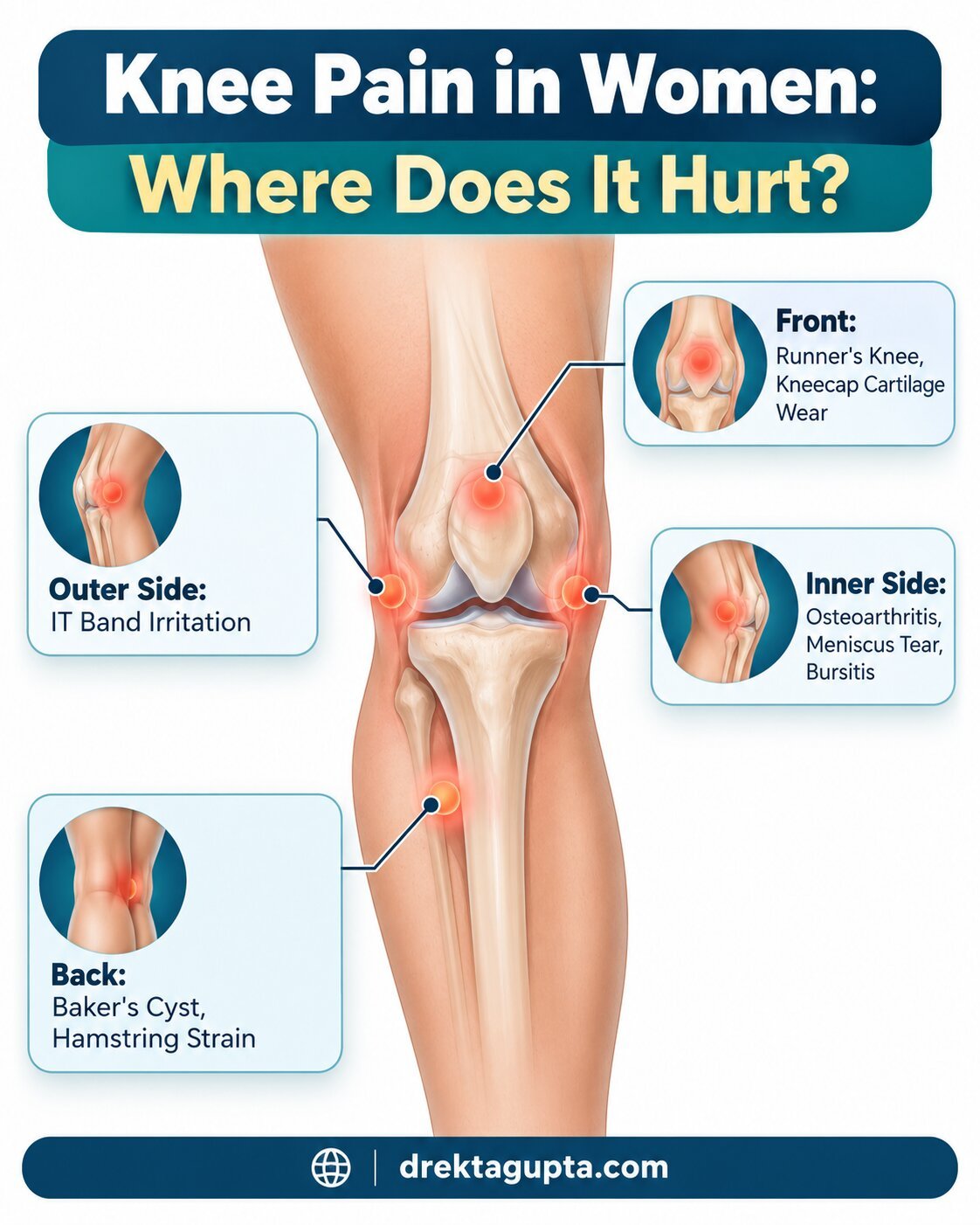
The spot where your knee hurts gives a good clue about the cause. This is not a substitute for a proper check-up, but it helps you understand what might be going on.
| Where the pain is | What it usually means |
| Front of the knee, around the kneecap | Runner’s knee, chondromalacia patella, early arthritis behind the kneecap |
| Inner side of the knee | Osteoarthritis (inner side wears first), meniscus tear, pes anserine bursitis |
| Outer side of the knee | IT band irritation (common in walkers and runners), outer meniscus tear |
| Back of the knee | Baker’s cyst (a fluid swelling linked with arthritis), hamstring strain |
| Whole knee, both sides, with swelling | Rheumatoid arthritis, advanced osteoarthritis, gout |
| Vague ache in both knees and legs | Vitamin D deficiency, weak bones, overall muscle weakness |
Knee Pain in Females by Age
The likely cause changes a lot with age, so it helps to look at it this way.
Teens to early 30s: Mostly runner’s knee, chondromalacia and sports injuries like ACL tears. Weak hip and thigh muscles are usually the root problem.
30s to mid 40s: Pregnancy-related pain, weight gain, early cartilage wear, rheumatoid arthritis (which often shows up in this window) and low vitamin D.
After 45 (around and after menopause): Osteoarthritis takes the lead. Drop in oestrogen, weight gain around menopause and weakening bones all come together. Pes anserine bursitis and meniscus tears are also common at this stage.
After 60: Advanced osteoarthritis, osteoporosis and reduced muscle strength. The focus here is on keeping her walking independently and avoiding falls.
When Should You See a Doctor?
Mild knee pain after a long day that settles with rest usually does not need a specialist. But please do not ignore it if you notice any of these:
- Pain that has lasted more than two to three weeks
- Swelling, warmth or redness around the knee
- The knee locks, catches or gives way while walking
- You cannot fully bend or straighten the leg
- Pain that wakes you up at night
- Difficulty climbing stairs, getting up from a chair or using the toilet
- Both knees and other joints hurting together with long morning stiffness
- Fever along with a swollen knee (this needs urgent attention)
The earlier knee problems are caught, the more options you have. Cartilage that is already lost cannot be fully brought back, but a lot can be done to slow it down and control the pain.
How Is Knee Pain in Women Diagnosed?
A good diagnosis starts with a proper conversation and examination, not just an X-ray. Your doctor will ask when the pain started, what makes it worse, and whether other joints are involved. Then she will check the knee for swelling, tenderness, movement, ligament stability and the alignment of your legs and feet.
Depending on what she finds, these tests may be advised:
- Standing X-ray of both knees to see the joint space and arthritis grade
- MRI if a ligament, meniscus or cartilage injury is suspected
- Blood tests such as vitamin D, calcium, thyroid, uric acid, and RA factor with anti-CCP if rheumatoid arthritis is suspected
- Ultrasound to look at bursitis, fluid or tendon problems
Effective Treatment for Knee Pain in Females
The right treatment depends on the cause and how advanced it is. The good part is that most women with knee pain do not need surgery. Treatment usually moves step by step, starting with the simplest options.
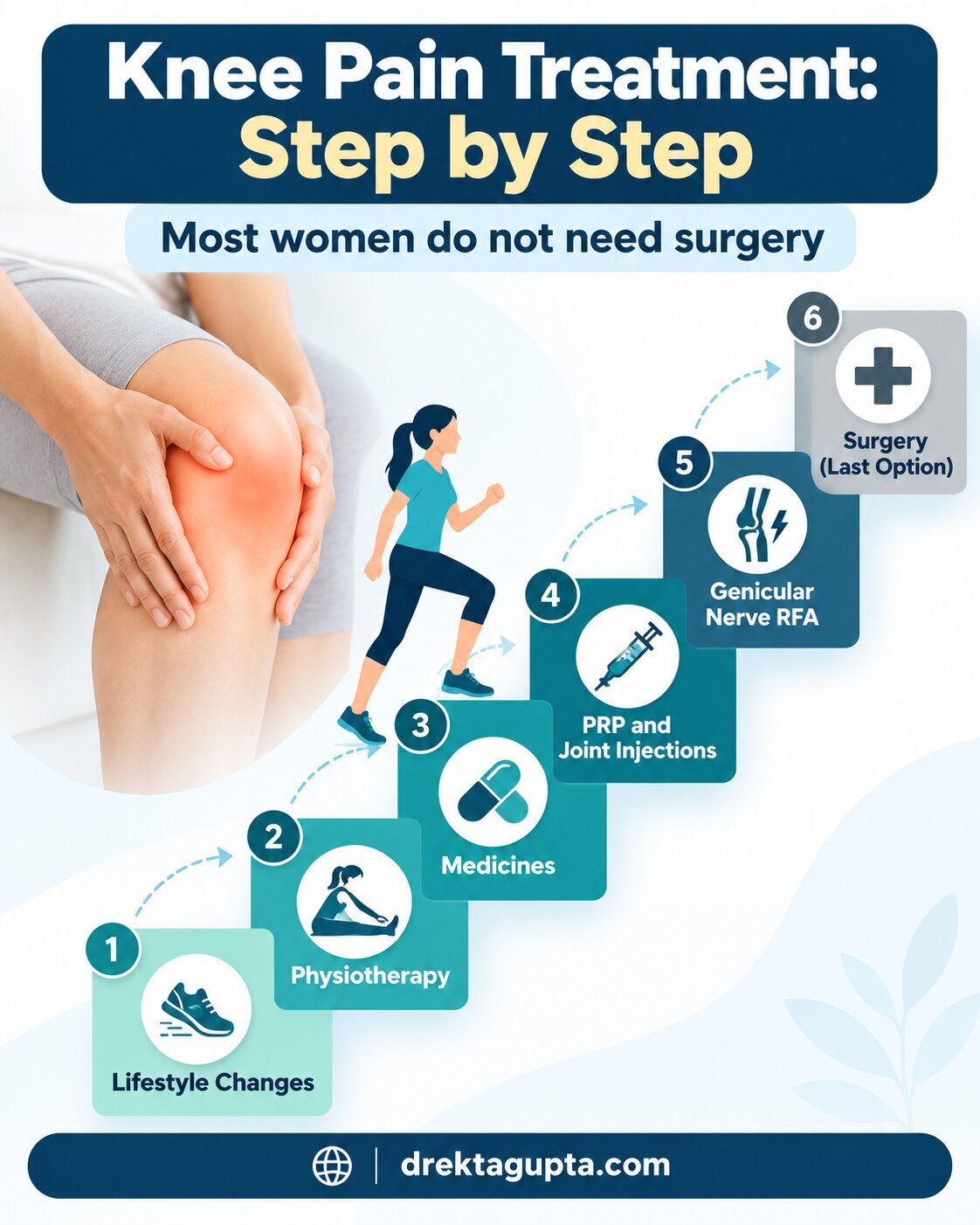
1. Lifestyle Changes That Actually Make a Difference
- Lose even a little weight. Losing 5 kilos takes roughly 20 kilos of load off the knee with every step on the stairs.
- Change how you sit. Use a chair or a low stool instead of sitting cross-legged on the floor for long periods. Switch to a Western-style toilet or add a commode chair.
- Take breaks while cooking. Shift weight between legs and sit down for chopping and other prep work.
- Choose your footwear wisely. Cushioned, flat or low-heel shoes with good arch support. Replace worn-out walking shoes.
- Get your vitamin D checked. If it is low, take supplements as prescribed, and get 15 to 20 minutes of morning sunlight on your arms and legs.
2. Physiotherapy and Strengthening
This is the most underrated treatment for knee pain in women. Strong thigh and hip muscles take load off the joint and help the kneecap track properly. For runner’s knee and early arthritis, a good strengthening programme alone can reduce pain significantly within six to eight weeks. A physiotherapist can also use heat, TENS and taping in the early painful phase.
3. Medicines
Painkillers and anti-inflammatory medicines help during flare-ups, but they should be taken for short periods and only on a doctor’s advice, as long-term use can affect the stomach and kidneys. Pain-relief gels are a safer option for daily use. Rheumatoid arthritis needs specific medicines (DMARDs) started early by a specialist.
4. Injection Treatments
When exercises and medicines are not enough, targeted injections can give relief for months:
- Steroid injection for a sudden painful flare with swelling, or for bursitis
- Hyaluronic acid (lubricant) injection to improve joint smoothness in mild to moderate arthritis
- PRP (platelet-rich plasma) injection, made from your own blood, to reduce pain and support healing in early to moderate arthritis and tendon problems. Read more in our guide on PRP injection cost in India.
- BMAC (bone marrow aspirate concentrate), a regenerative option for selected patients. We have explained who it suits in BMAC injection cost in India.
5. Genicular Nerve Block and Radiofrequency Ablation
This is a big change in how knee arthritis pain is treated today, and many women have never heard of it. The genicular nerves carry pain signals from the knee to the brain. A pain specialist can first block these nerves with an injection to check how much relief you get. If it works well, radiofrequency ablation (RFA) is done to switch off those pain signals for a longer period, often a year or more.
It is a daycare procedure done under local anaesthesia, with no cuts and no stitches. It is especially useful for older women with advanced arthritis who are not fit for surgery, or who want to delay knee replacement. You can read more about it in our detailed article on interventional pain management for knee osteoarthritis.
6. Surgery
Surgery is kept for when the knee is badly damaged and nothing else helps. Arthroscopy may be needed for certain ligament or meniscus injuries, and total knee replacement for end-stage arthritis. Even then, it is worth getting a pain specialist’s opinion first, because many women find enough relief with the options above to put surgery off for years.
Simple Exercises for Knee Pain at Home
These are gentle and safe for most women with mild knee pain. Do them on a mat or bed, not on a hard floor. Stop if any exercise makes the pain sharply worse, and check with your doctor if you have had a recent injury.
- Straight leg raise: Lie on your back, bend one knee, keep the other leg straight and lift it to the height of the bent knee. Hold for 5 seconds. Do 10 to 15 on each side.
- Quadriceps squeeze: Sit with legs straight, place a rolled towel under the knee and press it down by tightening the thigh. Hold for 10 seconds. Repeat 10 times.
- Clamshells: Lie on your side with knees bent. Keep feet together and lift the top knee like a clamshell opening. This strengthens the hip muscles that control the knee. Do 15 on each side.
- Sit to stand: Sit on a firm chair and stand up slowly without using your hands, then sit back down slowly. Start with 5 and build up to 15.
- Heel slides: Lie on your back and slowly slide one heel towards your bottom, then straighten again. Great for stiffness in the morning. Do 10 on each side.
What to avoid while your knee is painful: deep squats, sitting cross-legged for long, jumping, running on hard roads and climbing stairs repeatedly for exercise.
Get Expert Help for Knee Pain in Delhi
Knee pain does not have to become a part of your life just because you are a woman or crossing 40. With the right diagnosis and a step-by-step plan, most women get back to walking, climbing stairs and doing their daily work comfortably, without surgery.
Dr. Ekta Gupta, Pain Management Specialist (MBBS, MD, Fellowship Trained in Pain Medicine from AIIMS Delhi), treats knee pain with a non-surgical first approach, from guided physiotherapy and PRP to genicular nerve blocks and radiofrequency ablation. If your pain has been going on for months, our chronic pain treatment approach looks at the full picture, not just the knee.
Learn more about our knee pain treatment in Delhi or book a consultation at our Rajouri Garden clinic.
Call or WhatsApp: +91-9560852171 Visit: www.drektagupta.com
Frequently Asked Questions
Why do females get more knee pain than males?
Women have wider hips, which increases the angle at the knee and puts more stress on the joint. Lower oestrogen after menopause also speeds up cartilage wear, and women generally have less thigh muscle to protect the knee. Lifestyle factors like weight gain after pregnancy and low vitamin D add to it.
What is the most common cause of knee pain in women after 40?
Knee osteoarthritis is the most common cause after 40, especially around and after menopause. Weight gain, vitamin D deficiency and weak thigh muscles make it worse.
Can menopause cause knee pain?
Yes. Oestrogen helps protect cartilage and the tissues around the joint. When its level drops during menopause, many women notice new knee pain and stiffness, and existing arthritis can progress faster.
Can vitamin D deficiency cause knee pain?
Yes, it can. Low vitamin D is linked with knee osteoarthritis and with a general aching in the bones and muscles. It is very common in Indian women, so it is worth getting tested if you have unexplained knee or leg pain.
Is walking good for knee pain?
Walking on flat ground in good shoes is usually helpful for knee arthritis, as it keeps the joint moving and the muscles active. Start with short walks of 10 to 15 minutes and increase slowly. Avoid steep slopes and long stair climbs during a flare-up.
Can knee pain be treated without surgery?
In most women, yes. Weight control, strengthening exercises, physiotherapy, injections like PRP, and procedures like genicular nerve radiofrequency ablation can control pain well and delay or even avoid knee replacement.
Which doctor should I see for knee pain?
For long-standing knee pain, especially arthritis-related pain where you want to avoid surgery, a pain management specialist is a good first stop. For acute injuries needing surgical repair, an orthopaedic surgeon may be involved. Many women benefit from both working together.