
You bend down to pick up something, or you simply get up from a chair, and a sharp pain shoots from your lower back straight down into your leg. It may feel like a current, a burn or a deep ache. Some days the leg feels heavy. Some days there is a pins and needles feeling in the foot. Naturally, the first question in your mind is what exactly is going on inside.
Most people start searching for two words. Sciatica. Slipped disc. Very often these two get used as if they mean the same thing. They do not. One is a symptom and the other is a condition, and understanding the difference helps you ask the right questions and get the right treatment.
This guide explains the difference in simple language, tells you which symptoms point where, and helps you understand when it is time to see a pain specialist in Delhi.
First, Understand the Path of the Pain
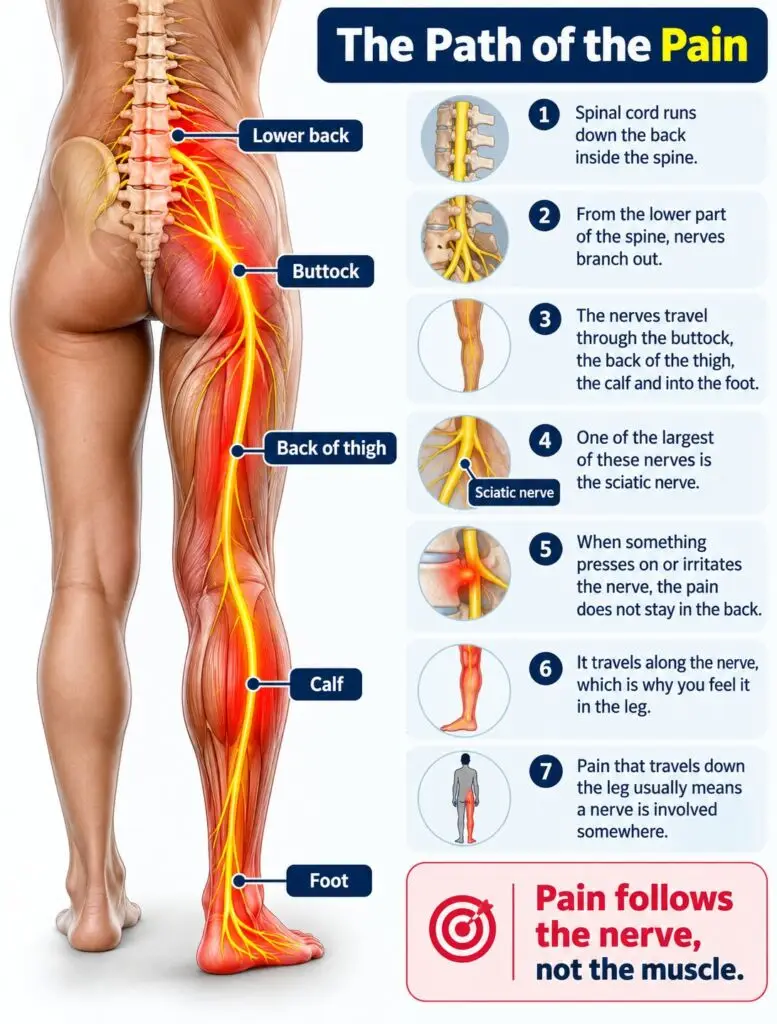
Before we go further, picture the wiring. Your spinal cord runs down the back inside the spine. From the lower part of the spine, nerves branch out and travel down through the buttock, the back of the thigh, the calf and into the foot. One of the largest of these nerves is the sciatic nerve.
When something presses on, or irritates, one of these nerves, the pain does not stay in the back. It travels along the nerve, which is why you feel it in the leg. This is the key point. Pain that travels down the leg usually means a nerve is involved somewhere. Finding out what is irritating that nerve is the real question.
 What Is Sciatica
Sciatica is not a disease in itself. It is a name for a set of symptoms. It describes pain, tingling, numbness or weakness that follows the path of the sciatic nerve, meaning from the lower back or buttock down into the leg, usually one side.
So when a doctor says you have sciatica, it means the sciatic nerve is irritated. It does not yet tell us why. The reason could be a disc, a narrowed spinal canal, a shifted vertebra, an injury or inflammation around the nerve.
You can read more about how this is evaluated and treated on the sciatica treatment page.
What Is a Slipped Disc
A slipped disc, also called a herniated disc or disc prolapse, is an actual condition. Between each pair of bones in your spine sits a soft cushion called a disc. It has a tough outer ring and a softer gel like centre.
With age, repeated strain or a sudden movement, the outer ring can weaken and the soft centre can bulge out or tear. When this bulge presses against a nearby nerve, it causes pain, tingling and numbness in the area that nerve supplies. In the lower back, this often means pain down the leg.
So a slipped disc is one specific reason why a person can get sciatica. It is a common reason, but not the only one.
The Simple Difference
Here is the easiest way to hold the two ideas in your head.
| Point | Sciatica | Slipped Disc |
|---|---|---|
| What it is | A symptom, pain along the sciatic nerve | A condition, a disc that has bulged or torn |
| What it tells you | A nerve is irritated | A specific structure is pressing the nerve |
| Where the problem sits | Anywhere along the nerve path | At a specific disc level in the spine |
| Can it happen without the other | Yes, other causes can cause sciatica | Yes, a disc can bulge without causing leg pain |
| How it is confirmed | By the pattern of symptoms and examination | By examination and, when needed, an MRI |
In short, sciatica is the complaint. A slipped disc is one possible explanation for that complaint.
Other Causes of Pain Travelling Down the Leg
A slipped disc is not the only culprit. Other reasons a nerve in the lower back can get irritated include:
- Spinal stenosis. The space around the nerves narrows, often with age, and squeezes them.
- Spondylolisthesis. One vertebra slips slightly over the one below and narrows the nerve pathway.
- Back injury. A fall, a sudden twist or an accident can inflame or press a nerve.
- Degenerative changes. Wear and tear in the discs and joints over the years can reduce the space around nerves.
- Piriformis related irritation. A tight muscle deep in the buttock can irritate the sciatic nerve.
- Inflammation. Swelling around a nerve can cause pain even when there is no obvious structural block.
This is exactly why a proper examination matters. Two people can describe the same pain in the leg, yet one has a disc problem and the other has stenosis. The treatment is not the same for both.
Symptoms That Point to Sciatica
Most people with sciatica describe some of these:
- Sharp, burning or shooting pain that starts in the lower back or buttock and travels down the leg
- Pain usually in one leg, though both legs can be affected in some cases
- Pins and needles or a tingling feeling along the leg or foot
- Numbness or reduced sensation in part of the leg or foot
- Weakness in the leg, ankle or foot
- Pain that gets worse with coughing, sneezing or straining
- Difficulty sitting for long, walking or doing normal daily work
If you want to understand how nerve related pain behaves differently from simple muscle pain, this page on nerve pain treatment explains it well.
Symptoms That Suggest a Slipped Disc
A slipped disc often shows up in a particular pattern, though not always. Clues include:
- Pain that started after bending, lifting or a sudden twist
- Pain that is clearly worse on one side
- Pain that increases when you sit for long, bend forward, cough or sneeze
- Pain that eases a little when you lie down or change position
- Tingling or numbness that follows a specific line down the leg
- Weakness in a specific movement, for example difficulty lifting the foot
An MRI is often the test that shows the disc clearly. But an MRI report alone does not decide treatment. Many people have a bulging disc on scan and no pain at all. What matters is how your symptoms, your examination and your scan fit together.
How a Doctor Tells the Difference
The process is more straightforward than most people expect.
Step 1, History. Your doctor asks where the pain starts, where it travels, what makes it worse and what makes it better. The pattern itself gives strong clues.
Step 2, Examination. Movement of the back, muscle strength, reflexes and sensation are checked. Simple tests, such as raising the leg straight, can suggest nerve irritation.
Step 3, Imaging when needed. An X ray or MRI is advised only when it is genuinely required. Not every case of leg pain needs an MRI.
Step 4, A plan. Once the source is clear, treatment is chosen for that specific problem.
This step by step approach is described on the back pain treatment page as well.
Why Treatment Is Often Similar at First
Here is something that surprises many patients. Whether the diagnosis is sciatica from a disc, or sciatica from another cause, the first line of treatment is often similar.
- Activity guidance, where sensible movement is encouraged instead of long bed rest
- Physiotherapy and graded exercises to build strength and support the spine
- Medication planning based on your symptoms and medical history
- Posture and daily habit correction
This is because the body often settles the irritation on its own with the right support. Most cases improve with time and correct care.
When Targeted Procedures Are Considered
If pain is severe, is not settling with conservative care, or is clearly nerve related, a specialist may consider targeted options.
- Epidural injection. An image guided injection can deliver medicine close to the irritated nerve to reduce pain and swelling. You can read more about this on the epidural injection cost in India page.
- Selective nerve root block. When one specific nerve root is suspected, a targeted block can confirm and treat it.
- Radiofrequency ablation. Used only for selected chronic pain sources, not for every case. Details are on the radiofrequency ablation cost in India page.
The important point is that these are chosen only after proper assessment. They are not given as a routine for everyone.
For long standing or recurring pain, a structured approach is discussed under chronic pain treatment.
Home Care That Actually Helps
A few simple habits make a real difference.
- Do not stay in bed for days. Gentle movement is usually better than long rest.
- Change position often. Sitting in one place for hours usually makes nerve pain worse.
- Use a firm mattress and a pillow under the knees when lying down to ease the back.
- Avoid bending and lifting heavy weight for some time.
- Use heat on tight muscles. A cold pack can help if the area feels fresh and inflamed.
- Keep moving within comfort. Short walks are often helpful.
- Do not ignore increasing weakness. That needs a doctor, not home care.
Simple Exercises That Are Often Suggested
Do these gently, and stop if any movement increases your pain or causes tingling.
- Knee to chest stretch. Lie on your back and bring one knee slowly towards the chest. Hold briefly. Repeat on the other side.
- Pelvic tilt. Lie on your back, flatten the lower back against the floor gently, hold for five seconds and release.
- Cat and camel. On all fours, slowly arch and then round the back in a gentle rhythm.
- Bridging. Lie on your back with knees bent, lift the hips slowly and lower.
- Nerve glide. A gentle, guided nerve movement, best done under a physiotherapist’s advice.
A physiotherapist can guide you better once your exact problem is known. Doing the wrong stretch for the wrong condition can make things worse.
When to See a Doctor
See a specialist if:
- Pain has lasted more than two to three weeks
- Pain is spreading down the leg with tingling or numbness
- You are getting weakness in the leg, ankle or foot
- Pain is disturbing your sleep or your work
- Home care and simple medicines are not helping
- The pain keeps coming back again and again
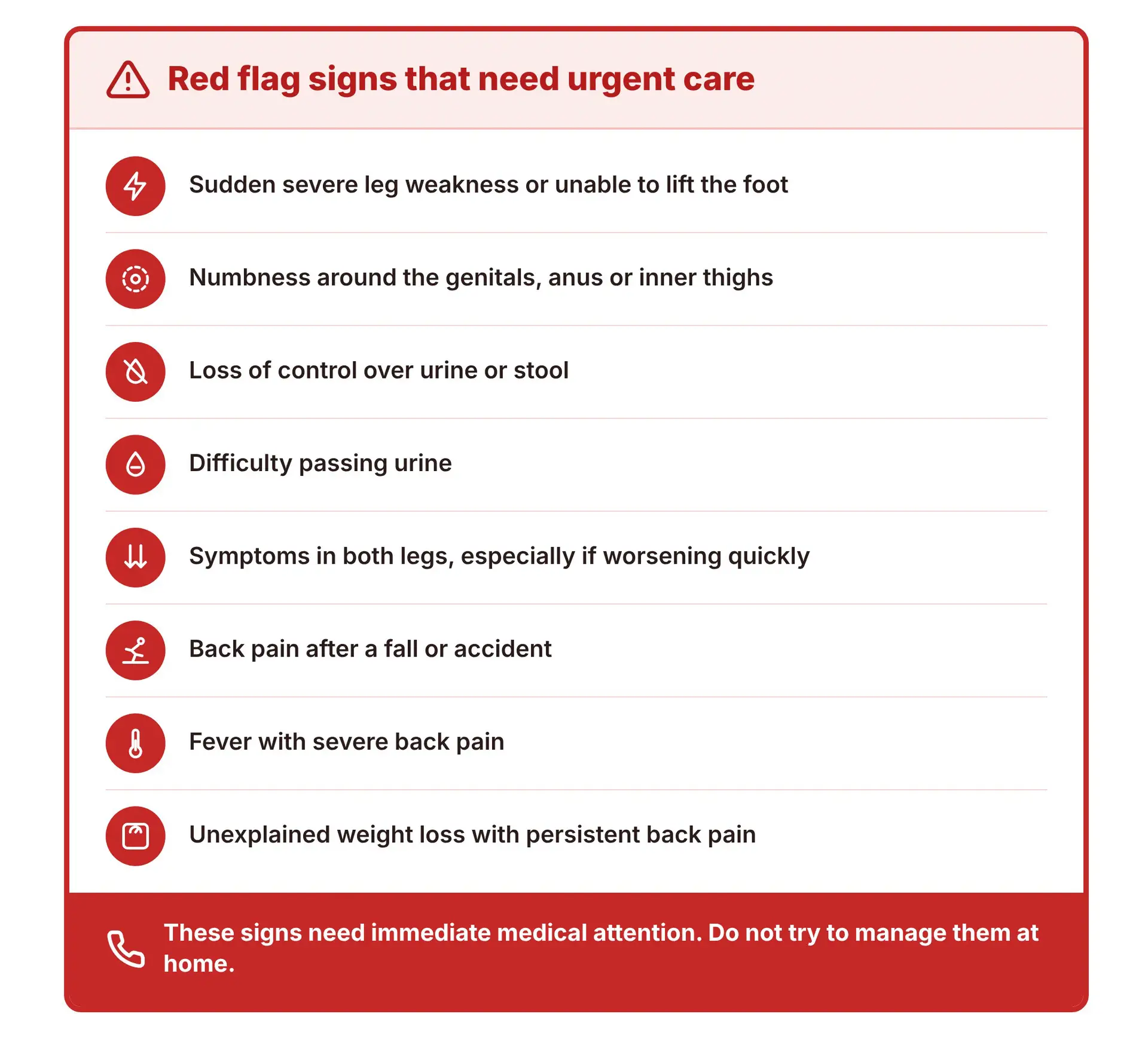
Red Flag Signs That Need Urgent Care
Please do not wait if you notice any of these.
- Sudden severe weakness in the leg, or you are unable to lift the foot
- Numbness around the genitals, anus or inner thighs
- Loss of control over urine or stool
- Difficulty passing urine
- Symptoms in both legs, especially if they are getting worse quickly
- Back pain after a fall or accident
- Fever with severe back pain
- Unexplained weight loss along with persistent back pain
These signs need immediate medical attention. Do not try to manage them at home.
Frequently Asked Questions
Can sciatica happen without a slipped disc?
Yes. Sciatica only means the sciatic nerve is irritated. A slipped disc is a common cause, but spinal stenosis, a back injury, degenerative changes and other reasons can also cause it.
Can a slipped disc be present without any pain?
Yes. Many people have a bulging disc visible on an MRI and feel completely fine. This is why the scan is always read along with your symptoms and examination.
Will a slipped disc always need surgery?
No. A large number of cases improve with conservative care, physiotherapy and appropriate treatment. Surgery is considered only in selected cases, such as severe or worsening weakness or when other treatment has not helped.
Is bed rest good for sciatica?
Long bed rest is usually not advised now. Short rest during a very painful phase is fine, but gentle movement is generally encouraged.
How long does it take to get better?
Many people start feeling better within a few weeks. Recovery time depends on the cause, the severity and how well the treatment and exercises are followed.
Can I do yoga with sciatica?
Some gentle poses can help, but others can worsen the problem. Always check with your doctor or physiotherapist before starting yoga, especially forward bending poses.
Do I need an MRI right away?
Not always. An MRI is advised based on your history and examination. If there are red flag signs, it may be needed sooner.
Does sitting for long hours make it worse?
For many people, yes. Long sitting increases pressure on the lower back. Taking short breaks and changing position helps. If you sit at a desk all day, the posture advice in this guide on neck pain while working on a laptop is useful for your back as well.
Talk to Dr. Ekta Gupta About Your Leg Pain
Dr. Ekta Gupta is a fellowship trained pain physician, MBBS, MD, with fellowship training from AIIMS Delhi, practising at Rajouri Garden, Delhi 110027. The focus is on finding the real source of the pain and treating it with a personalised, evidence based plan, so that you can move better and get back to your daily life.
If pain from your lower back to your leg is affecting your work, sleep or walking, you can book a consultation and get a proper assessment. You can also explore the full range of pain treatments offered at the clinic.
Clinic details
Phone and WhatsApp: +91 95608 52171
Timings: Monday to Saturday, 9:00 AM to 7:00 PM
Email: info@drektagupta.com