
Radiofrequency Ablation (RFA) Cost in India: Everything You Should Know
If you have been suffering from chronic back pain, neck pain, knee pain, arthritis pain, or nerve pain for several months and medicines or physiotherapy are not giving enough relief, your doctor may recommend Radiofrequency Ablation (RFA).
One of the first questions patients ask is:
“What is the Radiofrequency Ablation (RFA) cost in India?”
The answer depends on several factors like the condition being treated, number of nerves involved, hospital, city, imaging guidance, and doctor’s expertise.
In this detailed guide, we explain the latest RFA treatment cost in India, what affects the pricing, who is a suitable candidate, recovery, and whether the procedure is worth it.
What is Radiofrequency Ablation (RFA)?
Radiofrequency Ablation (RFA) is a minimally invasive pain management procedure used to reduce chronic pain by interrupting pain signals from specific nerves.
During the procedure:
- A thin needle is placed near the painful nerve under X-ray guidance.
- Radiofrequency energy generates controlled heat.
- The heat temporarily disables the nerve carrying pain signals.
- Healthy surrounding tissues remain protected.
The procedure usually takes 20-45 minutes and most patients go home the same day.
Unlike major surgery, there are no large cuts, no stitches, and recovery is much faster. RFA is widely used for chronic pain conditions and often provides pain relief lasting several months or longer.
Radiofrequency Ablation (RFA) Cost in India
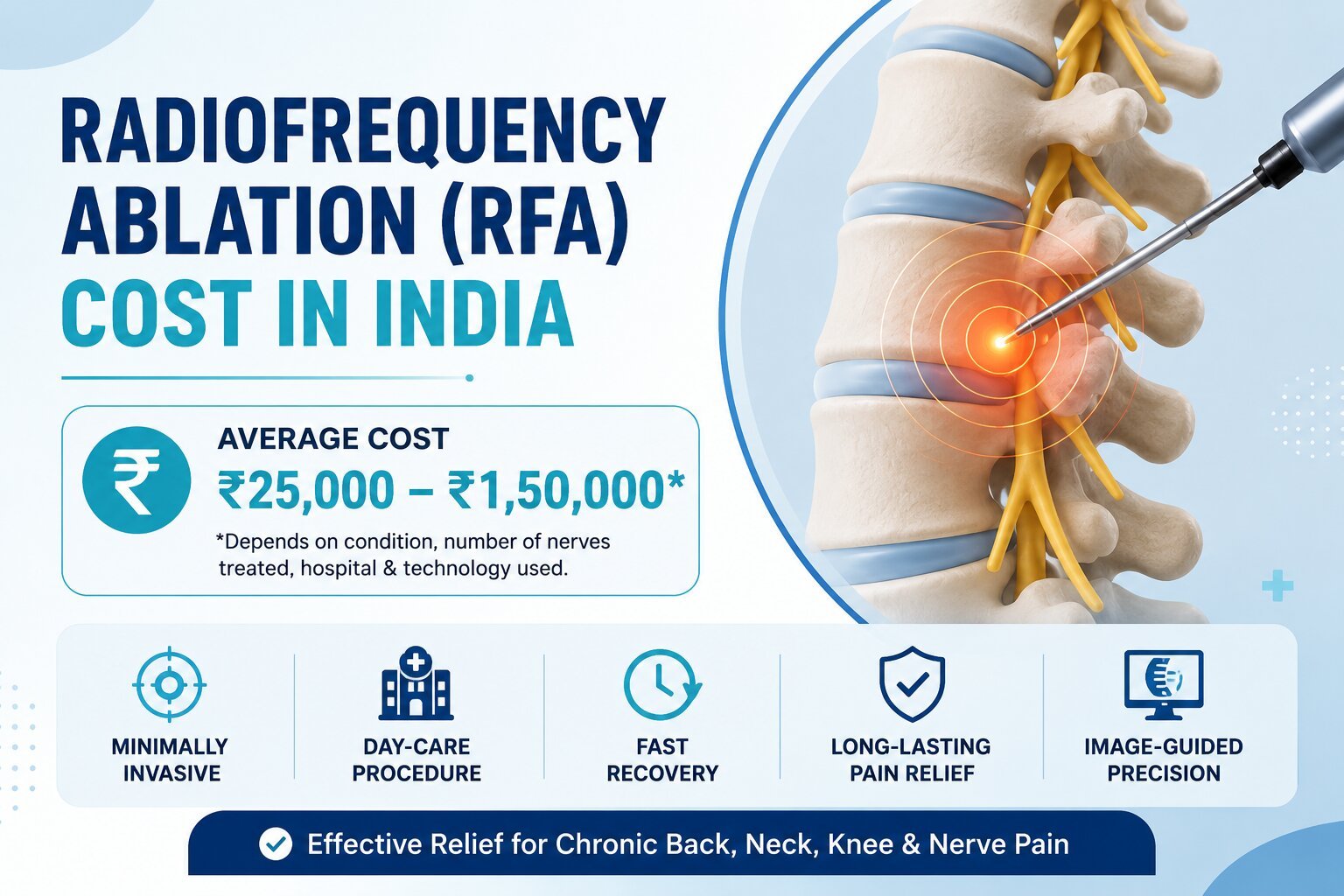
The average Radiofrequency Ablation cost in India ranges between ₹25,000 and ₹1,00,000 per session.
For complex cases involving multiple nerves or advanced techniques, the cost may increase to ₹1,50,000 or more depending on the hospital and treatment plan.
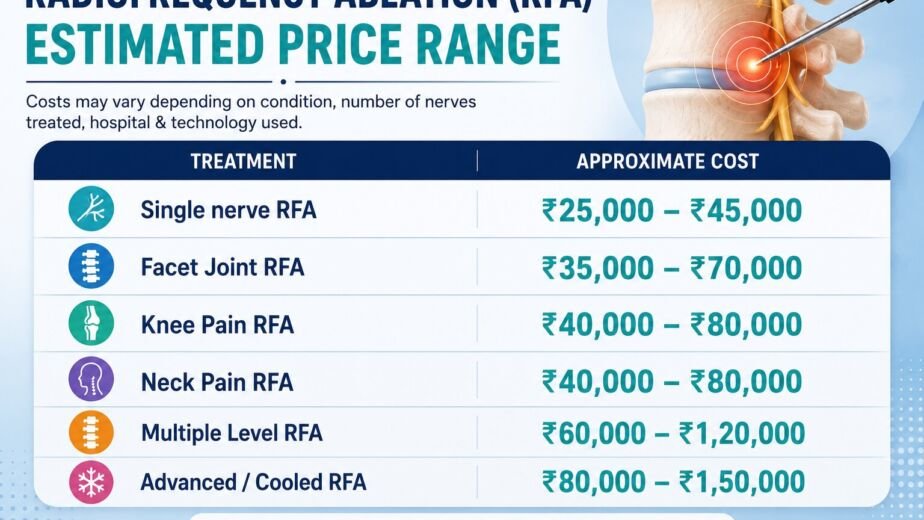
Estimated Price Range
| Treatment | Approximate Cost |
| Single nerve RFA | ₹25,000 – ₹45,000 |
| Facet Joint RFA | ₹35,000 – ₹70,000 |
| Knee Pain RFA | ₹40,000 – ₹80,000 |
| Neck Pain RFA | ₹40,000 – ₹80,000 |
| Multiple Level RFA | ₹60,000 – ₹1,20,000 |
| Advanced/Cooled RFA | ₹80,000 – ₹1,50,000 |
These are approximate costs. The final price depends on your diagnosis and treatment plan.
Radiofrequency Ablation Cost in Major Indian Cities
| City | Approximate Cost |
| Delhi | ₹40,000 – ₹90,000 |
| Mumbai | ₹50,000 – ₹90,000 |
| Bangalore | ₹50,000 – ₹90,000 |
| Hyderabad | ₹45,000 – ₹90,000 |
| Chennai | ₹45,000 – ₹90,000 |
| Pune | ₹45,000 – ₹90,000 |
Prices may vary between hospitals and pain clinics.
Why is there such a big difference in RFA cost?
This is where many patients get confused. One hospital may give a modest estimate, while another may quote a much higher figure. That does not always mean one place is overcharging. Often, it simply means the procedure details are different.
The final RFA cost in India may depend on:
- Condition being treated
RFA may be used for chronic spine pain, trigeminal neuralgia, knee pain, arrhythmias or tumour-related treatment, and the cost changes with the complexity of the case.
- Type of RFA procedure
Some centres mention different types such as pulsed radiofrequency and cooled radiofrequency ablation. Technique, equipment and number of nerves treated can affect the total bill.
- Hospital category and city
The cost may vary depending on whether treatment is done in a metro city, high-end hospital, day-care setup, private room or suite category. Yashoda and Medicover both mention hospital type or ward category as a cost factor.
- Imaging guidance and procedure setup
Pain RFA is usually done using X-ray or ultrasound guidance for accuracy. The use of image guidance, procedure room charges and monitoring can change the price.
- Doctor expertise
An experienced pain specialist may charge differently depending on training, case complexity and the type of hospital where the procedure is performed.
- Insurance coverage
Some hospitals clearly mention that insurance support can influence the patient’s out-of-pocket expense.
When is RFA usually advised?
RFA is generally considered when:
- pain has been present for a long time
- medicines are giving only temporary relief
- physiotherapy has not solved the problem
- the source of pain has been properly identified
- surgery is not immediately needed or the patient wants to delay surgery
- diagnostic nerve blocks suggest that RFA may help
It is commonly used in patients with chronic back pain, neck pain, facet joint pain, sacroiliac joint pain, arthritis-related pain and selected knee pain cases.
If knee arthritis pain is the main issue, you can also read this page on Interventional Pain Management for Knee Osteoarthritis, where RFA is explained as one of the useful non-surgical options on drektagupta.com.
Is radiofrequency ablation a surgery?
No, not in the usual sense.
RFA is generally a day-care, minimally invasive procedure. In many cases, patients go home the same day. Published hospital pages say recovery is usually faster than major surgery, and patients often return to normal activities soon, depending on the area treated and doctor advice.
How long does pain relief last after RFA?
Relief duration can vary from one patient to another. Yashoda notes that RFA relief may last from around 3 to 12 months, and in some cases the procedure may be repeated if pain comes back.
This is important for patients to understand: RFA is not a magic cure for every pain condition, but in the right patient, it can reduce pain significantly and improve day-to-day activity.
Is RFA worth the cost?
For many patients, yes, especially when pain is affecting walking, sitting, sleeping, bending or working, and daily medicines are no longer enough.
RFA may be worth considering because it can:
- reduce pain without major surgery
- improve movement and function
- reduce dependence on painkillers in some patients
- help delay surgery in selected cases
- allow quicker return to routine compared to major procedures
Still, the decision should never be based on price alone. The real question is not only “How much does RFA cost?” but also “Will it help my type of pain?”
What questions should you ask before going for RFA?
Before booking the procedure, it is sensible to ask:
- What exactly is the source of my pain?
- Why are you recommending RFA in my case?
- Will I need a diagnostic block first?
- Is the quoted amount inclusive of imaging guidance and day-care charges?
- How many nerves or levels will be treated?
- How long is the expected relief?
- Will I need physiotherapy after the procedure?
- Is insurance accepted?
These questions help patients compare treatment options properly instead of comparing only the starting price.
Radiofrequency ablation vs other pain treatments
RFA is usually one part of a bigger pain management plan. Depending on the diagnosis, some patients may benefit more from medicines, physiotherapy, joint injections, nerve blocks or regenerative procedures.
For example, if shoulder pain and stiffness are the main problem, this guide on Frozen Shoulder Injection Cost in India explains how injection-based treatment costs can vary and how doctors decide between different options.
Who should consult a pain specialist for RFA?
You should consider a pain specialist consultation if:
- your back or neck pain keeps returning
- you have arthritis-related pain that is not settling
- your knee pain continues despite medicines and exercise
- your pain is affecting sleep, work or daily activity
- you want to avoid or delay surgery if safely possible
At Dr Ekta Gupta, patients can get evaluated for chronic pain conditions with a focus on advanced, evidence-based and minimally invasive pain care.
Final word
The radiofrequency ablation RFA cost in India can vary widely, but for many chronic pain patients, it remains an important non-surgical treatment option. A fair, patient-friendly way to understand the pricing is this: some centres may start around ₹25,000, many patients may see quotes in the ₹50,000 to ₹1,50,000 range, and higher costs are possible in more complex hospital-based cases.
The best next step is to get a proper diagnosis first. Once the pain source is confirmed, your doctor can tell you whether RFA is suitable, what kind of relief you may expect, and what the actual cost would be in your case.
FAQs
1. What is the average radiofrequency ablation RFA cost in India?
Published hospital websites in India show a broad range. Many patients may find estimates between ₹50,000 and ₹1,50,000, while some centres list lower or higher prices depending on the indication and hospital setup.
2. Why does RFA cost vary so much in India?
Because RFA is used for different conditions, and the price changes based on the type of procedure, hospital, city, ward category, doctor team and insurance coverage.
3. Is RFA a day-care procedure?
In many pain management cases, yes. Hospital and specialist sources describe it as a minimally invasive day-care procedure with relatively quick recovery.
4. How long does relief last after radiofrequency ablation?
It varies. Some hospital guidance says relief may last several months, and the procedure can be repeated in selected patients if pain returns.
5. Is radiofrequency ablation better than surgery?
Not always. It depends on the diagnosis. For the right patient, RFA can offer good pain relief without major surgery, but it is not a replacement for every surgical condition.

3 Comments