
Why the Laptop Is Hard on Your Neck
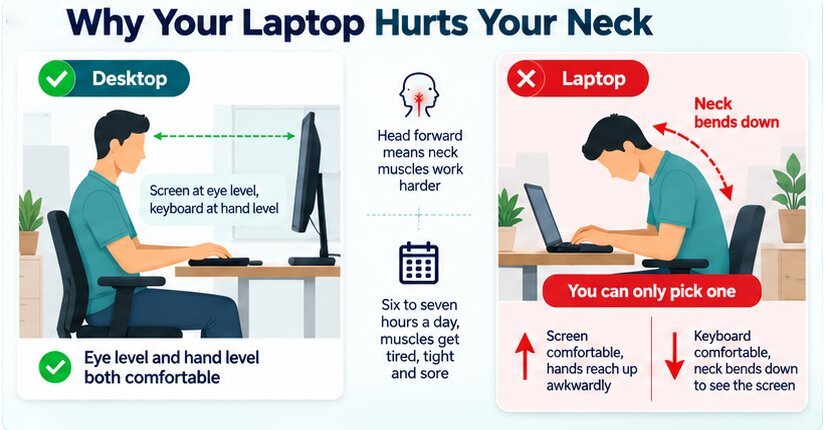
A desktop computer lets you keep the screen at eye level and the keyboard at hand level. A laptop forces you to choose one. If the screen is at a comfortable height, your hands reach up awkwardly. If the keyboard is comfortable, you end up bending your neck down to see the screen.
That forward bending is the problem. Every time you drop your head forward, the muscles at the back of your neck have to work harder to hold it up. Do this for six or seven hours a day, day after day, and those muscles get tired, tight and sore. Over months, the strain can also affect the joints and discs in the neck.
This is the same reason why the term “tech neck” has become so common. It simply describes neck pain and stiffness caused by long hours of looking down at a laptop or phone.
Common Causes of Neck Pain From Laptop Work
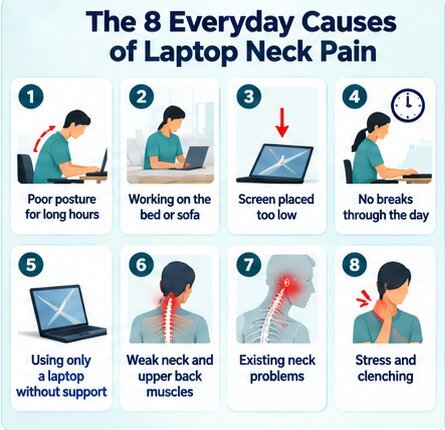
1. Poor posture for long hours
Most of us sit with the head pushed forward, shoulders rounded and the back curved. In this position the neck is not supported by the spine, so the muscles do all the work. The result is a tired, aching neck by evening.
2. Working on the bed or sofa
This is very common in Indian homes. Sitting cross legged on the bed with the laptop on the lap feels relaxed, but the neck and lower back get no support at all. The same happens on a sofa that is too soft or too deep.
3. Screen placed too low
When the laptop sits on a table and you look down at it, the neck stays bent for hours. A low screen is one of the simplest reasons for daily neck stiffness.
4. No breaks through the day
Muscles recover when you move. If you sit in one position for hours without getting up, the neck muscles stay contracted and gradually become painful.
5. Using only a laptop without support
Small laptop screens and low keyboards make it almost impossible to keep a neutral posture. Without a stand, an external keyboard or a separate monitor, the neck pays the price.
6. Weak neck and upper back muscles
If the muscles that support the neck and shoulder blades are weak, even normal desk work starts to feel heavy. This is often seen in people who have stopped all physical activity.
7. Existing neck problems
People who already have cervical spondylosis, a disc problem or a previous injury are more likely to feel pain during laptop work. If you want to understand this in Hindi, you can read this simple explainer on सर्वाइकल क्या होता है.
8. Stress and clenching
When we are stressed, we tend to hold tension in the neck and shoulders without realising it. Deadlines and long meetings often add this hidden layer to the pain.
Symptoms You May Notice
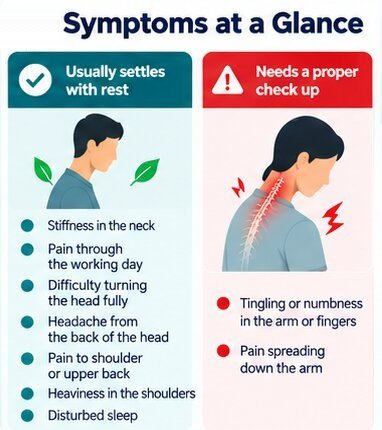
Most people with laptop related neck pain describe some of these:
- Stiffness in the neck, especially in the morning or after long sitting
- Pain that builds up through the working day
- Difficulty turning the head fully while driving or reversing a car
- Headache starting from the back of the head
- Pain spreading to the shoulder or upper back
- A feeling of heaviness in the shoulders
- Tingling or numbness in the arm or fingers, which points to nerve irritation
- Disturbed sleep because of discomfort
If your pain is only in the muscles and settles with rest, it is usually not a worry. But when pain starts moving down the arm or comes with numbness, it deserves a proper check up.
Simple Home Remedies That Help
Before we talk about exercises, a few everyday habits make a real difference.
Fix your sitting setup
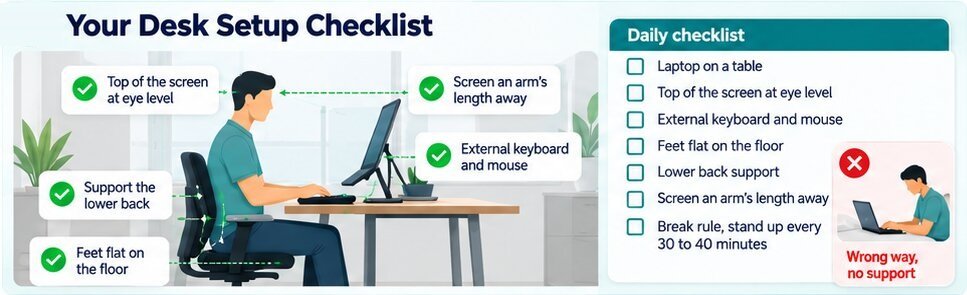
- Keep the laptop on a table, not on your lap or bed.
- Raise the laptop so the top of the screen is at eye level. A stack of books works fine.
- Use an external keyboard and mouse so your shoulders stay relaxed.
- Keep the feet flat on the floor or on a small stool.
- Support the lower back with a cushion or a rolled towel.
- Keep the screen an arm’s length away.
Take short breaks
Follow a simple rule. Every 30 to 40 minutes, stand up for two minutes. Walk to the kitchen, roll your shoulders, look far away. These small breaks do more for the neck than one long stretch at the end of the day.
Use heat or cold
A warm compress or a hot water bag on the neck muscles helps relax tightness. If the area feels fresh and inflamed after a long day, a cold pack for ten minutes can calm it down.
Check your pillow
A pillow that is too high or too flat keeps the neck bent all night. Choose one that supports the natural curve of the neck. Sleeping on the stomach is best avoided.
Stay hydrated and active
Muscles work better when you drink enough water and stay generally active. A daily walk of 30 minutes is simple and very effective.
Manage screen time on the phone
The phone adds to the same problem. Bring the phone up to eye level instead of bending the neck down to look at it.
Easy Neck Exercises You Can Do at Home
Do these gently. If any movement increases your pain or causes tingling in the arm, stop and get it checked.
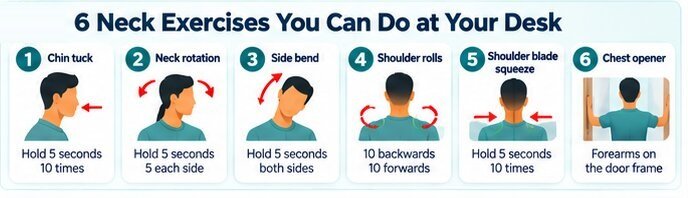
1. Chin tuck
Sit straight. Gently pull your chin straight back, as if making a double chin. Hold for five seconds. Repeat 10 times. This is one of the best exercises for laptop posture.
2. Neck rotation
Slowly turn your head to the right until you feel a mild stretch. Hold for five seconds. Repeat on the left. Do 5 on each side.
3. Side bend
Tilt your head towards the right shoulder without lifting the shoulder. Hold for five seconds. Repeat on the other side.
4. Shoulder rolls
Roll both shoulders backwards in slow circles, 10 times. Then forwards 10 times.
5. Shoulder blade squeeze
Pull both shoulder blades together as if holding a pencil between them. Hold for five seconds. Repeat 10 times. This strengthens the upper back.
6. Chest opener
Stand in a doorway, place your forearms on the frame and gently lean forward. This stretches the chest and relieves the rounded shoulder position.
A physiotherapist can guide you better once your exact problem is known. At our clinic, posture correction and physiotherapy based rehabilitation are planned according to the diagnosis, not as a fixed routine for everyone.
When Should You See a Doctor
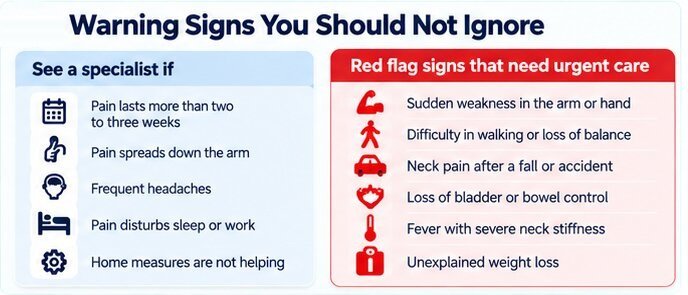
See a specialist if:
- The pain has lasted more than two to three weeks
- Pain is spreading down the arm with tingling or numbness
- You are getting frequent headaches along with neck pain
- Pain is disturbing your sleep or work
- Simple home measures are not helping
Red flag signs that need urgent care
Please do not wait if you notice any of these:
- Sudden severe weakness in the arm or hand
- Difficulty in walking or loss of balance and coordination
- Neck pain after a fall or accident
- Loss of bladder or bowel control along with neck or back pain
- Fever with severe neck stiffness
- Unexplained weight loss along with persistent neck pain
These signs need immediate medical attention.
How a Pain Specialist Assesses Neck Pain
At the clinic, the first step is always a detailed discussion about your symptoms, your work routine, how long you sit and what treatments you have already tried. This is followed by an examination of neck movement, muscle strength, sensation and the likely source of pain.
Imaging such as an X-ray or MRI is advised only when it is genuinely needed, based on your history and examination. Not every neck pain patient requires an MRI.
Once the source is clear, treatment is planned for that specific problem. Options may include:
- Ergonomic and posture correction advice
- Physiotherapy and a graded strengthening programme
- Medication planning as per your medical history
- Image guided injections for selected nerve related neck pain
- Facet joint procedures when the joints are the pain source
- Radiofrequency ablation for selected chronic pain, only after proper diagnostic assessment
[Infographic Placeholder 6: How a Pain Specialist Assesses and Treats Neck Pain]
The aim is never just to reduce pain for a few days. It is to help you move better, work comfortably and prevent the problem from returning. If your neck pain is linked to nerve symptoms going down the arm, it is worth reading about nerve pain treatment and how it differs from simple muscular pain. Many patients also have pain in the lower back from the same long sitting hours, and that is assessed and managed through back pain treatment along with the neck.
Small Changes, Big Relief
Neck pain from laptop work is rarely about one single thing. It is the result of many small habits repeated every day. Change the height of your screen, take those short breaks, do a few minutes of exercise and sleep on a proper pillow. Most people feel better within a few weeks.
If the pain keeps coming back, or if it is affecting your work and sleep, a proper assessment helps you understand what is actually going on and what treatment will suit you.
Frequently Asked Questions
1. Can laptop work permanently damage my neck?
Long hours of poor posture can contribute to muscle strain, joint changes and disc related problems over time. With early correction of posture, exercise and timely treatment, most people recover well. Permanent damage is not the usual outcome.
2. Is tech neck the same as cervical spondylosis?
No. Tech neck usually refers to muscle strain and stiffness from screen use. Cervical spondylosis is an age related change in the neck joints and discs. Both can cause similar symptoms, which is why an examination is important.
3. Can I get relief without surgery?
Yes. A large number of neck pain cases are managed with posture correction, physiotherapy, medication and selected minimally invasive procedures, depending on the diagnosis.
4. Which pillow is best for neck pain?
A pillow that supports the natural curve of the neck and keeps the head in line with the spine is best. Very high or very flat pillows usually make things worse.
5. How many hours of laptop work is safe?
There is no fixed number. What matters is your posture and your breaks. Two hours of sitting badly can cause more trouble than six hours with good posture and regular movement.
6. Should I use a laptop stand?
Yes, a laptop stand with an external keyboard and mouse is one of the simplest and most effective changes you can make.
7. When should I consult a pain specialist?
If the pain lasts beyond two to three weeks, spreads into the arm, comes with numbness, or keeps returning despite home care, it is time to consult a specialist.
Talk to Dr. Ekta Gupta About Your Neck Pain
Dr. Ekta Gupta is a fellowship trained pain physician, MBBS, MD, with fellowship training from AIIMS Delhi, practising at Rajouri Garden, Delhi 110027. The clinic focuses on finding the real source of pain and treating it with a personalised, evidence based plan, so that you can move better and get back to your normal routine.
If neck pain is affecting your work, sleep or daily life, you can book a consultation and get a proper assessment. You can also explore the full range of pain treatments offered at the clinic.