
How Much Does PRP Cost in India?
So your doctor has said, “Let’s try PRP before thinking about surgery.” You nodded, went home, and the very first thing you typed into Google was “PRP cost in India”. Fair enough. Most of our patients ask us the same thing in the first five minutes of the consultation: Doctor, kitna kharcha aayega?
Here is the short answer. In India, one session of PRP for joint, tendon or back pain usually costs Rs 6,000 to Rs 25,000. A full course of 1 to 3 sessions comes to roughly Rs 15,000 to Rs 70,000, depending on the condition and the type of injection.
That range is wide, and there is a reason for it. A quick PRP shot for tennis elbow and an image-guided PRP injection into the sacroiliac joint are two very different procedures, even though both are called “PRP”. Also, a lot of prices you see online are for hair PRP, which is cheaper and works differently. In this article, Dr. Ekta Gupta, Pain Management Specialist (MBBS, MD, Fellowship Trained, AIIMS Delhi), breaks down PRP cost condition by condition and injection type by injection type, so you know what a fair quote looks like before you walk into any clinic.
What Are You Actually Paying For in a PRP Injection?
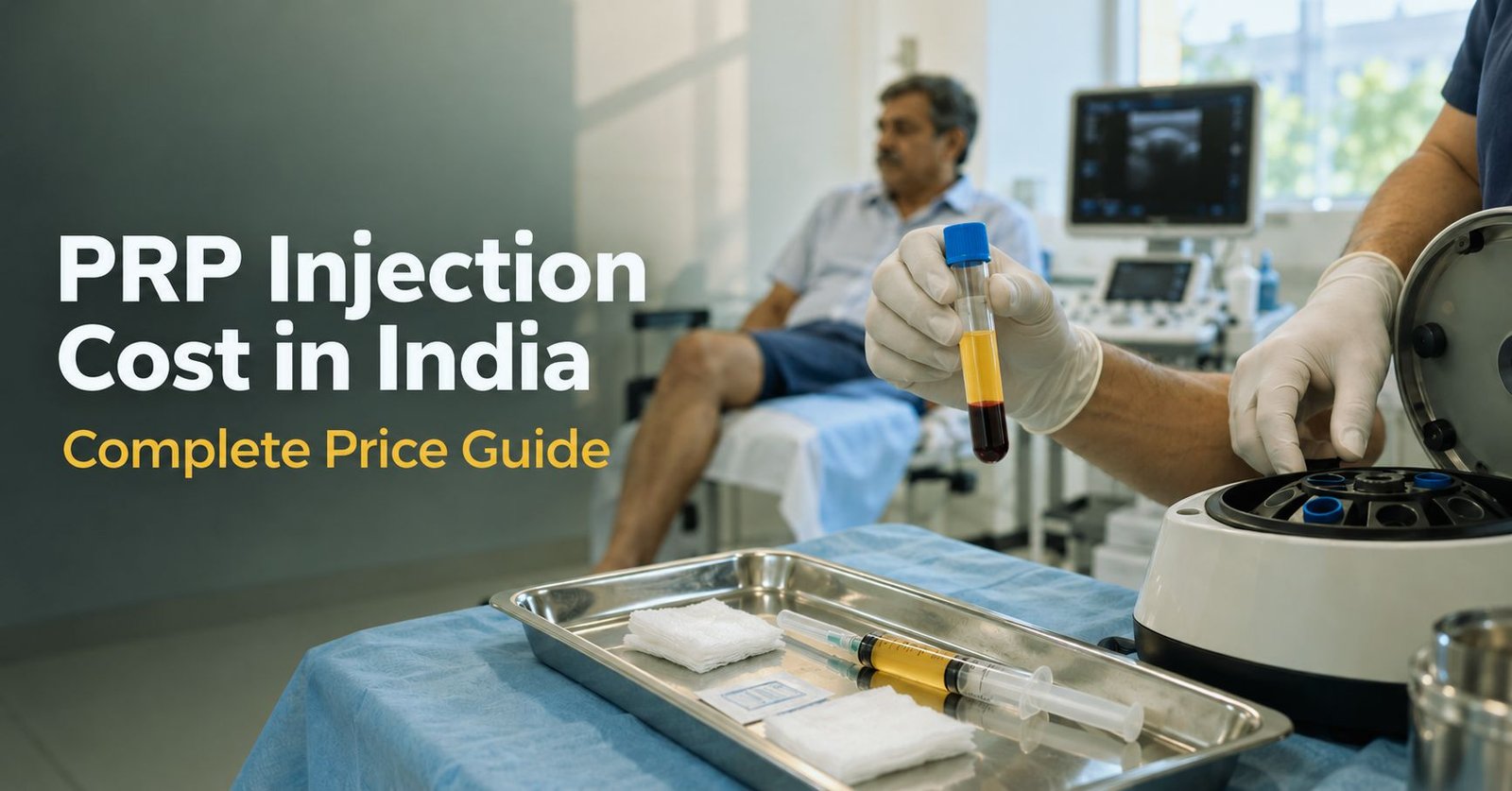
PRP stands for Platelet-Rich Plasma. The doctor takes a small amount of your own blood, spins it in a centrifuge to separate the platelets, and injects that concentrated plasma into the painful joint or tendon. Platelets carry growth factors that help damaged tissue repair itself. Since it is your own blood, there is no risk of allergy or rejection.
When a clinic quotes you a price, it is usually covering these things:
- Blood draw and processing. Around 15 to 60 ml of blood is taken, depending on the area being treated.
- The PRP kit or tubes. This is the single biggest variable. A basic lab tube costs a few hundred rupees, while a branded, closed-system PRP kit can cost several thousand.
- Centrifuge time and preparation. Some clinics do a single spin, some do a double spin to get a higher platelet count.
- Image guidance. Ultrasound or fluoroscopy (C-arm) helps the doctor place the needle exactly where the damage is.
- Sterile procedure setup. Gloves, drapes, local anaesthetic, dressing and a clean procedure room.
- The doctor’s skill and time. A PRP injection is only as good as where it lands.
- Follow-up review. Many clinics include one follow-up visit in the package.
Once you understand this list, the price differences between clinics start making a lot more sense.
PRP Cost in India by Condition
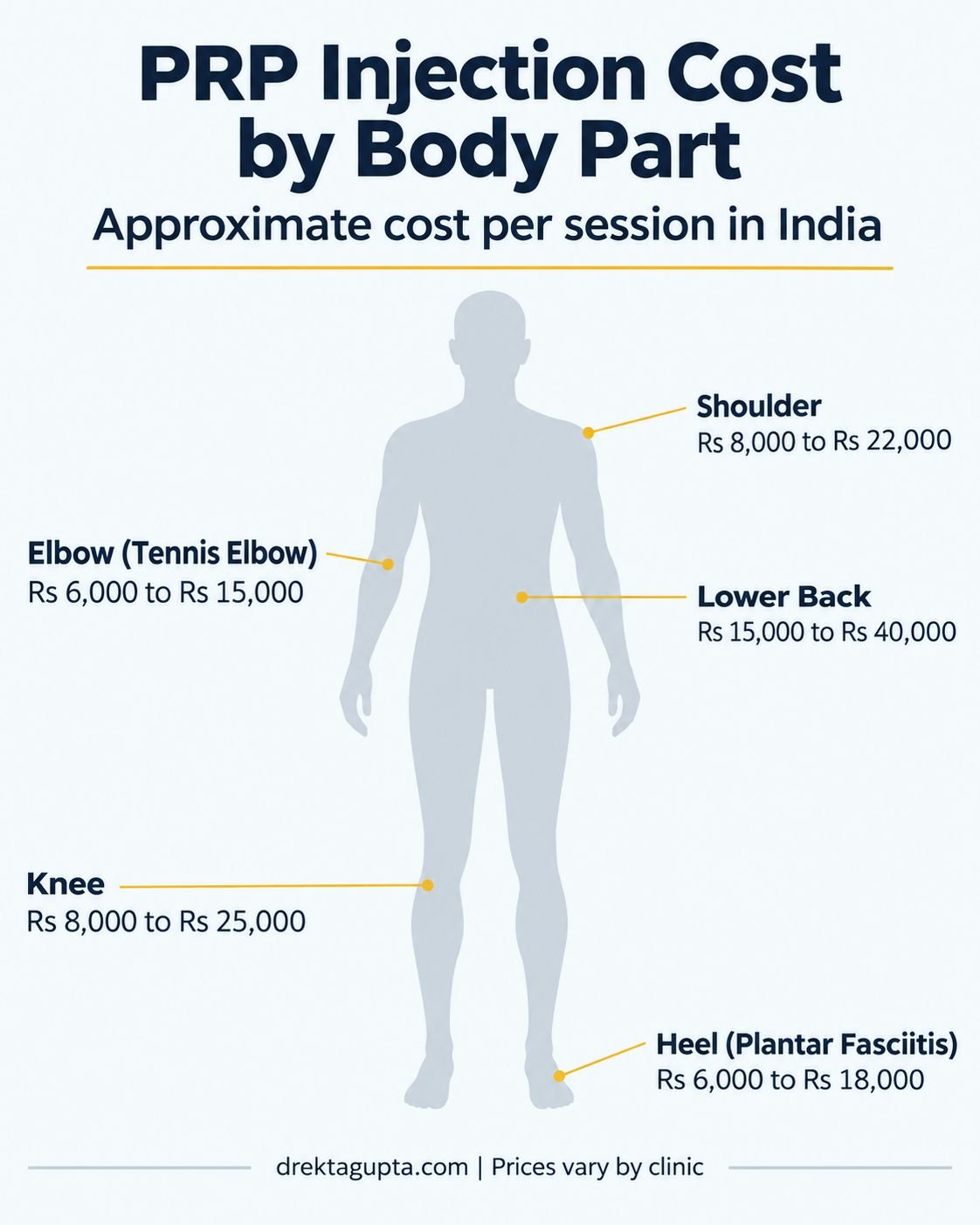
The table below gives approximate ranges seen across clinics in Delhi NCR and other metro cities in 2026. Treat it as a guide, not a rate card. Your final quote will depend on your scans, the severity of the problem and the plan your doctor makes.
| Condition | Usual sessions | Cost per session (Rupees) | Approx. total (Rupees) |
| Knee osteoarthritis (one knee) | 1 to 3 | Rs 8,000 to Rs 25,000 | Rs 15,000 to Rs 60,000 |
| Both knees | 1 to 3 | Rs 14,000 to Rs 40,000 | Rs 25,000 to Rs 1,00,000 |
| Shoulder (rotator cuff, tendinitis) | 1 to 3 | Rs 8,000 to Rs 22,000 | Rs 15,000 to Rs 55,000 |
| Tennis elbow / golfer’s elbow | 1 to 2 | Rs 6,000 to Rs 15,000 | Rs 6,000 to Rs 30,000 |
| Plantar fasciitis / Achilles pain | 1 to 2 | Rs 6,000 to Rs 18,000 | Rs 6,000 to Rs 35,000 |
| Back pain (facet or SI joint) | 1 to 2 | Rs 15,000 to Rs 40,000 | Rs 15,000 to Rs 75,000 |
| Sports injury (ligament, muscle tear) | 1 to 2 | Rs 8,000 to Rs 20,000 | Rs 8,000 to Rs 40,000 |
| Hair loss (for comparison only) | 4 to 6 | Rs 3,000 to Rs 15,000 | Rs 15,000 to Rs 75,000 |
PRP for Knee Pain
Knee osteoarthritis is the most common reason people come to us for PRP, and it is also where the research is strongest. PRP works best in early to moderate arthritis, when there is still some cartilage left to protect. In bone-on-bone arthritis, honestly, the results are limited.
A knee PRP session usually costs Rs 8,000 to Rs 25,000. The higher end is for clinics that use a branded kit and ultrasound guidance. Most patients need one to three injections, a few weeks apart. If both knees are involved, expect the cost to go up, though many clinics offer a lower combined rate. You can read more about non-surgical options in our blog on interventional pain management for knee osteoarthritis, or visit our knee pain treatment in Delhi page.
PRP for Shoulder Pain
PRP is used for rotator cuff tendinopathy, partial tears and chronic shoulder tendinitis. The shoulder is a deeper, trickier joint, so ultrasound guidance makes a real difference here. That is why shoulder PRP often costs Rs 8,000 to Rs 22,000 per session.
One thing patients often get confused about: PRP is usually not the first choice for frozen shoulder. Procedures like hydrodilatation or a suprascapular nerve block tend to work better there. Our pages on shoulder pain treatment and frozen shoulder treatment explain the difference.
PRP for Tennis Elbow and Golfer’s Elbow
This is one of the cheaper PRP procedures, usually Rs 6,000 to Rs 15,000 per session. The tendon is close to the skin, a smaller volume of PRP is needed, and one or two sessions are often enough. Tennis elbow is also one of the conditions where PRP has good evidence, especially when it has not settled with rest and physiotherapy.
PRP for Heel Pain (Plantar Fasciitis) and Achilles Tendon
If you have that sharp heel pain with your first few steps in the morning, you probably know the name plantar fasciitis already. PRP here costs around Rs 6,000 to Rs 18,000 per session. Achilles tendon problems need more care, because the injection must avoid weakening the tendon, so guidance is strongly preferred.
PRP for Back Pain
PRP for the spine is a more specialised procedure. It is used for facet joint pain, sacroiliac (SI) joint pain and, in selected cases, disc-related pain. These injections are deep and must be done under fluoroscopy or ultrasound in a proper procedure room, often by an interventional pain specialist.
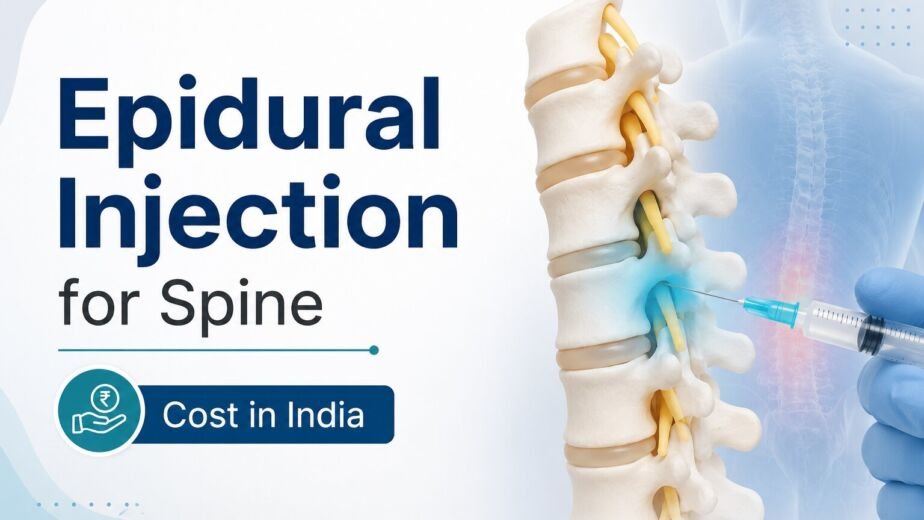
That is why spinal PRP costs more, typically Rs 15,000 to Rs 40,000 per session. If your back pain is coming from a nerve, an epidural may be the better option. Our article on epidural injection cost in India covers that in detail. You can also check our back pain treatment page.
PRP for Sports Injuries
Partial ligament injuries, hamstring strains, patellar tendinitis (jumper’s knee) and similar problems in active people often respond well to PRP combined with rehab. Cost is usually Rs 8,000 to Rs 20,000 per session. See our sports injury pain treatment page for more.
PRP Cost in India by Injection Type
Two clinics can both say “PRP” and still be offering quite different things. These are the main differences that change the price.
| Injection type | What it means | Effect on cost |
| Manual (tube) PRP | Blood spun in standard lab tubes, plasma separated by hand | Lowest cost |
| Kit-based PRP | Branded closed-system kit, more consistent platelet count | Adds about Rs 3,000 to Rs 10,000 |
| Leukocyte-poor PRP | Fewer white cells, usually preferred for joints like the knee | Similar to kit-based |
| Leukocyte-rich PRP | More white cells, sometimes used for stubborn tendon problems | Similar to kit-based |
| Landmark (blind) injection | Doctor injects by feel, no imaging | No extra charge |
| Ultrasound-guided | Needle tracked live on ultrasound screen | Adds about Rs 2,000 to Rs 6,000 |
| Fluoroscopy (C-arm) guided | X-ray guidance in a procedure room, mostly for the spine | Adds about Rs 5,000 to Rs 15,000 |
Manual PRP vs Kit-Based PRP
Manual preparation is cheaper, and in experienced hands it can work fine. The problem is consistency. The platelet count can vary quite a bit from one batch to the next. Commercial kits are designed to give a more predictable concentration, which matters for joints and tendons. If a clinic quotes you a very low price, it is worth asking which method they use.
Leukocyte-Poor vs Leukocyte-Rich PRP
This sounds technical, but it is simple. Leukocytes are white blood cells. For knee arthritis, leukocyte-poor PRP is generally preferred because it causes less flare-up inside the joint. For some long-standing tendon problems, doctors may choose leukocyte-rich PRP. The price difference between the two is small. What matters more is that your doctor picks the right one for your condition.
Blind Injection vs Image-Guided Injection
This is where we feel patients should pay the most attention. Studies have shown that injections given without guidance can miss the target, especially in the shoulder, hip and spine. If the PRP does not reach the damaged tissue, you have paid for nothing.
Ultrasound guidance adds a few thousand rupees to the bill, but it greatly improves accuracy for deep joints and tendons. Fluoroscopy is the standard for spinal PRP. For a superficial area like tennis elbow, a skilled doctor may not always need imaging.
Other Things That Affect PRP Price
Apart from the condition and the injection type, a few more factors push the price up or down:
- PRP in Delhi, Mumbai or Bengaluru usually costs more than in a tier 2 city, mainly because of rent and running costs.
- Hospital vs specialist clinic. Big corporate hospitals add facility and admission charges. A dedicated pain clinic is often more affordable for the same procedure.
- Who is doing it. A fellowship-trained pain specialist or sports medicine doctor may charge more than a general practitioner, but you are paying for correct diagnosis and accurate placement.
- Number of areas treated. Two knees or a knee plus a shoulder means more blood, more kits and more time.
- Combination treatment. Some plans combine PRP with hyaluronic acid, prolotherapy or physiotherapy, sold as a package.
Hidden Costs to Ask About
Before you agree to a package, ask for an all-inclusive quote. The add-ons below are not always mentioned upfront:
- Consultation fee (Rs 800 to Rs 2,000 in most Delhi clinics)
- Blood tests like CBC, and blood sugar if you are diabetic
- X-ray or MRI, if you don’t already have recent scans
- Painkillers or supplements after the procedure
- Physiotherapy sessions, which are often needed for the best result
- Follow-up visit charges
Is Very Cheap PRP a Red Flag?
Not always, but often. If someone is offering joint PRP for Rs 2,000 or Rs 3,000, it is fair to ask a few questions. How much blood will they draw? Single spin or double spin? Will they use ultrasound? Who will give the injection, the doctor or an assistant? A low price usually means a corner is being cut somewhere, and with PRP, the corner that gets cut is usually platelet quality or accuracy.
PRP vs Other Treatment Options: Cost Comparison
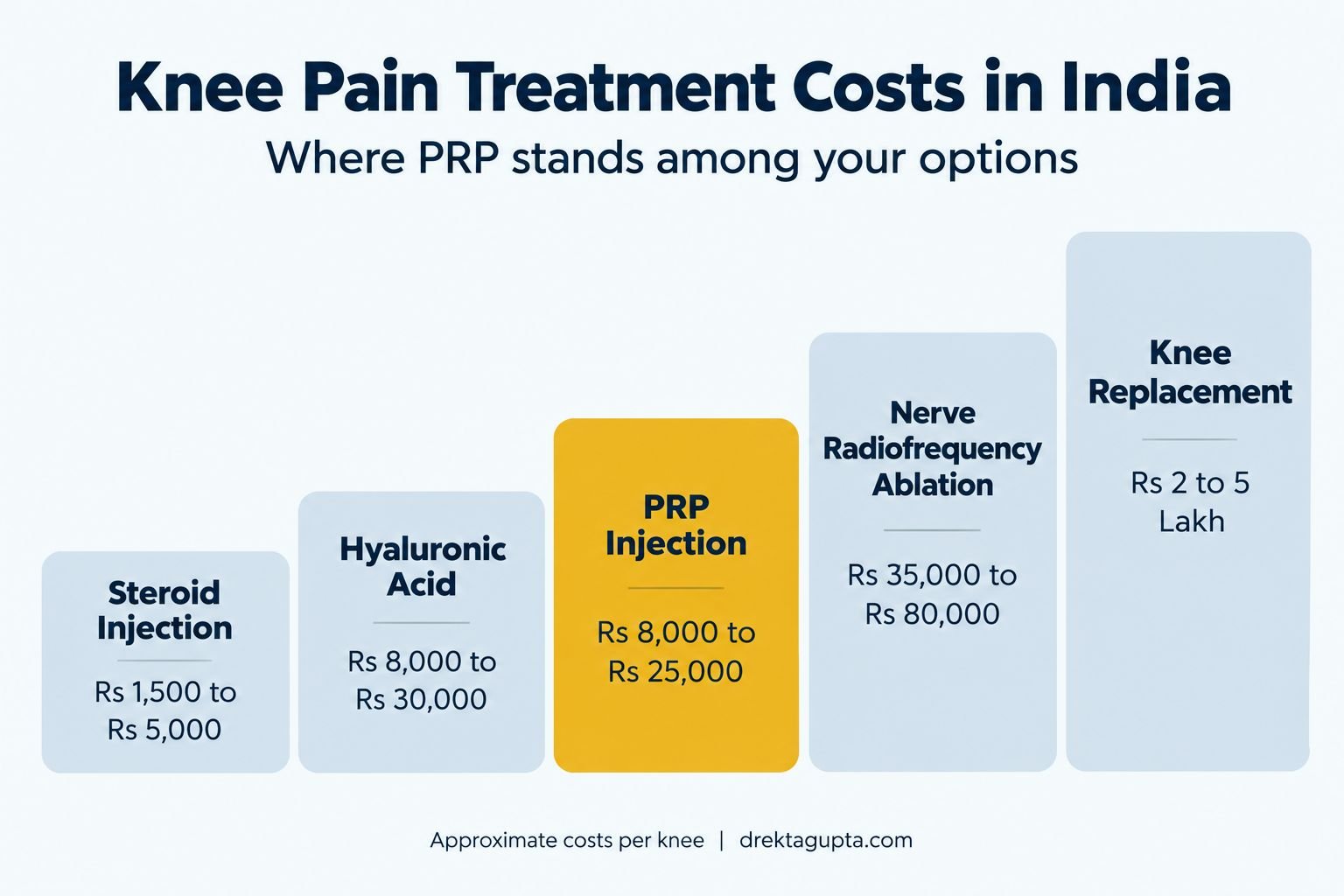
PRP is not the cheapest injection, but it is not the most expensive option either. Here is how it compares for knee pain, using approximate 2026 ranges in Indian metros.
| Treatment | Approx. cost (Rupees) | Relief usually lasts |
| Steroid injection | Rs 1,500 to Rs 5,000 per shot | Few weeks to 3 months |
| Hyaluronic acid (viscosupplementation) | Rs 8,000 to Rs 30,000 per course | 6 to 12 months |
| PRP injection | Rs 8,000 to Rs 25,000 per session | 6 to 12 months, sometimes longer |
| Genicular nerve radiofrequency ablation | Rs 35,000 to Rs 80,000 | 6 to 18 months |
| Total knee replacement | Rs 2,00,000 to Rs 5,00,000 per knee | Many years, with a long recovery |
Steroids work fast but wear off, and repeated shots are not great for cartilage. PRP takes 4 to 6 weeks to kick in, but when it works, the relief tends to last longer. For many people in their 40s, 50s and early 60s, PRP is a sensible way to delay surgery without spending lakhs.
How Many PRP Sessions Will You Need?
For most joint and tendon problems, one to three sessions is the norm. Many patients with tennis elbow or plantar fasciitis need just one. Knee arthritis often needs two or three, spaced two to four weeks apart.
Be a little careful if someone pushes a six-session package for your knee. Hair PRP needs many sessions, but for orthopaedic pain there is very little research supporting that many injections. A good doctor will review you after each session and decide whether another one is actually needed.
Does Health Insurance Cover PRP in India?
In most cases, no. PRP is done as a day-care or OPD procedure without hospital admission, and most mediclaim policies in India do not include it. Some policies with OPD cover may reimburse part of the cost, so it is worth calling your insurer. Ask the clinic for a proper bill and prescription in case you want to file a claim.
Who Should (and Shouldn’t) Get PRP?
PRP is a good option if you have:
- Early to moderate knee or hip arthritis
- Chronic tendon pain like tennis elbow, rotator cuff tendinopathy, jumper’s knee or Achilles pain
- Plantar fasciitis that has not improved after a few months of exercises and footwear changes
- Partial ligament or muscle injuries from sports
- Certain types of facet or SI joint back pain, after proper evaluation
PRP may not suit you if you have a low platelet count, an active infection, a blood-related cancer, severe end-stage arthritis, or if you are pregnant. If you take blood thinners, tell your doctor beforehand, as they may need to be managed. Diabetes is not a barrier, but sugar control helps healing.
What Happens on the Day of PRP?
The whole procedure usually takes 45 minutes to an hour. Blood is drawn from your arm, processed while you wait, and then injected after numbing the area. Most people walk out on their own and go back to light work the next day.
Some soreness for two to three days is normal. Avoid painkillers like ibuprofen or diclofenac for about a week, because they can dull the healing response. Paracetamol is usually fine, but follow your doctor’s advice. Real improvement typically shows up after four to six weeks, and it keeps building for a few months.
PRP Treatment in Delhi with Dr. Ekta Gupta
At Dr. Ekta Gupta’s Pain Management Clinic in Rajouri Garden, New Delhi, we do not start with the injection. We start with the question, “Is PRP actually right for you?” Sometimes the honest answer is no, and a nerve block, an epidural or a good physiotherapy plan will do the job better and cost less.
When PRP is the right choice, the injection is planned around your condition, from choosing the type of PRP to placing it under image guidance where needed. Dr. Ekta Gupta is an AIIMS Delhi trained, fellowship-trained Pain Management Specialist who treats knee, shoulder, back, neck and chronic pain without surgery wherever possible.
The exact cost of your PRP treatment will be shared clearly after your consultation, with no surprises later. To book an appointment, call or WhatsApp +91 95608 52171, or contact us here.
Frequently Asked Questions
What is the cost of one PRP injection in India?
One PRP injection for joint or tendon pain usually costs Rs 6,000 to Rs 25,000 in India. Spinal PRP done under fluoroscopy can go up to Rs 40,000 per session. Hair PRP is cheaper, at around Rs 3,000 to Rs 15,000.
What is the PRP knee injection cost in Delhi?
In Delhi NCR, PRP for one knee generally costs Rs 10,000 to Rs 25,000 per session. The price depends on the kit used, whether ultrasound guidance is included, and the clinic.
Is PRP better than a steroid injection?
Steroids give quicker relief, but it usually fades in a few weeks to months. PRP takes longer to work, but the benefit often lasts 6 to 12 months or more. Your doctor will suggest what fits your condition.
How long does PRP take to show results?
Most people start noticing improvement in four to six weeks. The full effect may take two to three months.
Is PRP painful?
The area is numbed with local anaesthetic, so the injection itself is quite tolerable. Some soreness and stiffness for a couple of days afterwards is normal.
Can PRP avoid knee replacement surgery?
In early and moderate arthritis, PRP can reduce pain and help delay surgery, sometimes by years. In advanced bone-on-bone arthritis, it is less likely to help.
Is PRP covered by insurance in India?
Most health insurance policies in India do not cover PRP, as it is an OPD procedure. Check with your insurer if you have OPD cover.
Final Word
PRP cost in India is not one fixed number. It depends on what is being treated, how the PRP is prepared, and whether the injection is guided to the right spot. A cheaper quote is not always a saving if the injection misses its target. The smarter move is to get a proper diagnosis first, understand exactly what is included in the price, and then decide. If you are dealing with knee, shoulder, heel or back pain and want to know whether PRP makes sense for you, book a consultation with Dr. Ekta Gupta in Rajouri Garden, Delhi.
Disclaimer: Prices mentioned are approximate ranges for 2026 and vary between clinics. This article is for general information and is not a substitute for medical advice.


1 Comment