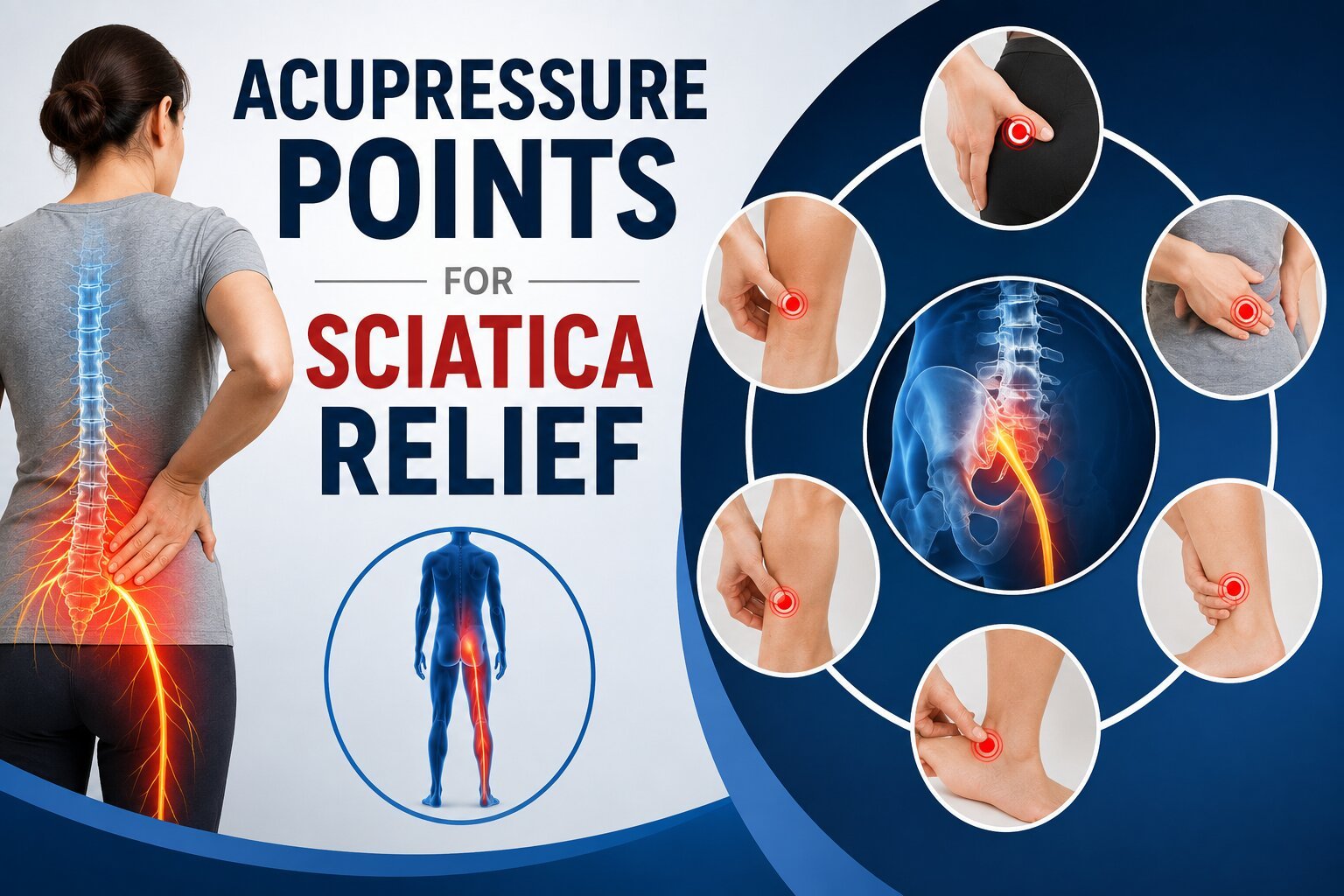
Acupressure Points for Sciatica Relief: 6 Pressure Points You Can Try at Home
Sciatica can be a very uncomfortable type of pain. It may start in the lower back or buttock and travel down the back of the thigh, calf or even up to the foot. Some people also experience tingling, numbness, burning or weakness in the affected leg.
Because of this, many people look for acupressure points for sciatica relief that they can try at home.
Acupressure involves applying pressure with your fingers or thumb to specific areas of the body. It is commonly used as a complementary approach for pain relief. Research has found that acupressure may help reduce pain in some people with low-back pain, although the quality of evidence is not strong enough to consider it a replacement for medical treatment.
If you want to try acupressure for sciatica, gentle pressure around certain areas may provide temporary comfort. However, it is important to understand that pressing a point cannot remove a slipped disc or directly release pressure on a compressed spinal nerve.
In this article, we will discuss some commonly used pressure points for sciatica, how to use them safely, and when you should see a pain specialist instead of depending only on home remedies.
What Is Sciatica?
Sciatica is a type of nerve pain that usually affects one side of the body.
The sciatic nerve is a large nerve that runs from the lower back through the buttock and down the leg. When one of the nerves coming from the lower spine becomes irritated or compressed, pain and other symptoms may travel along the path of the nerve.
Common symptoms include:
- Pain in the lower back or buttock
- Pain travelling down one leg
- Burning or shooting pain
- Tingling or pins and needles
- Numbness in the leg or foot
- Weakness in the leg or foot
- Pain that becomes worse with certain movements
A slipped or herniated disc is one common cause of sciatica. Other causes can include narrowing of the spinal canal, changes in the spine with age and some types of spinal injury.
Not every person with back pain has sciatica. Sciatica generally involves pain or other nerve symptoms that travel into the leg.
Can Acupressure Help With Sciatica?
This is an important question.
There is some evidence that acupressure can help reduce pain in people with low-back pain. A systematic review and meta-analysis of 23 randomised controlled trials involving 2,400 people found that acupressure was associated with improvements in pain and disability. However, the researchers also noted significant differences between the studies and downgraded the overall quality of evidence.
Research on acupuncture, which uses needles rather than finger pressure, is more extensive for sciatica. Several systematic reviews have reported possible improvements in pain with acupuncture, but more recent reviews have also pointed out limitations such as study quality, differences between treatment methods and possible publication bias.
So, it is reasonable to think of acupressure as a complementary method that may help with comfort, rather than a proven cure for sciatica.
Acupressure cannot:
- Remove a slipped disc
- Repair a damaged spinal nerve
- Correct spinal stenosis
- Replace necessary medical treatment
- Guarantee permanent relief from sciatica
If your symptoms are persistent or severe, finding the underlying cause is more important than repeatedly pressing painful areas.
6 Acupressure Points for Sciatica Relief
The following areas are commonly used in traditional acupressure and have also appeared in research involving low-back pain or acupuncture treatment for sciatica.
We are using simple descriptions rather than complicated traditional names, so you can easily understand where the areas are located.
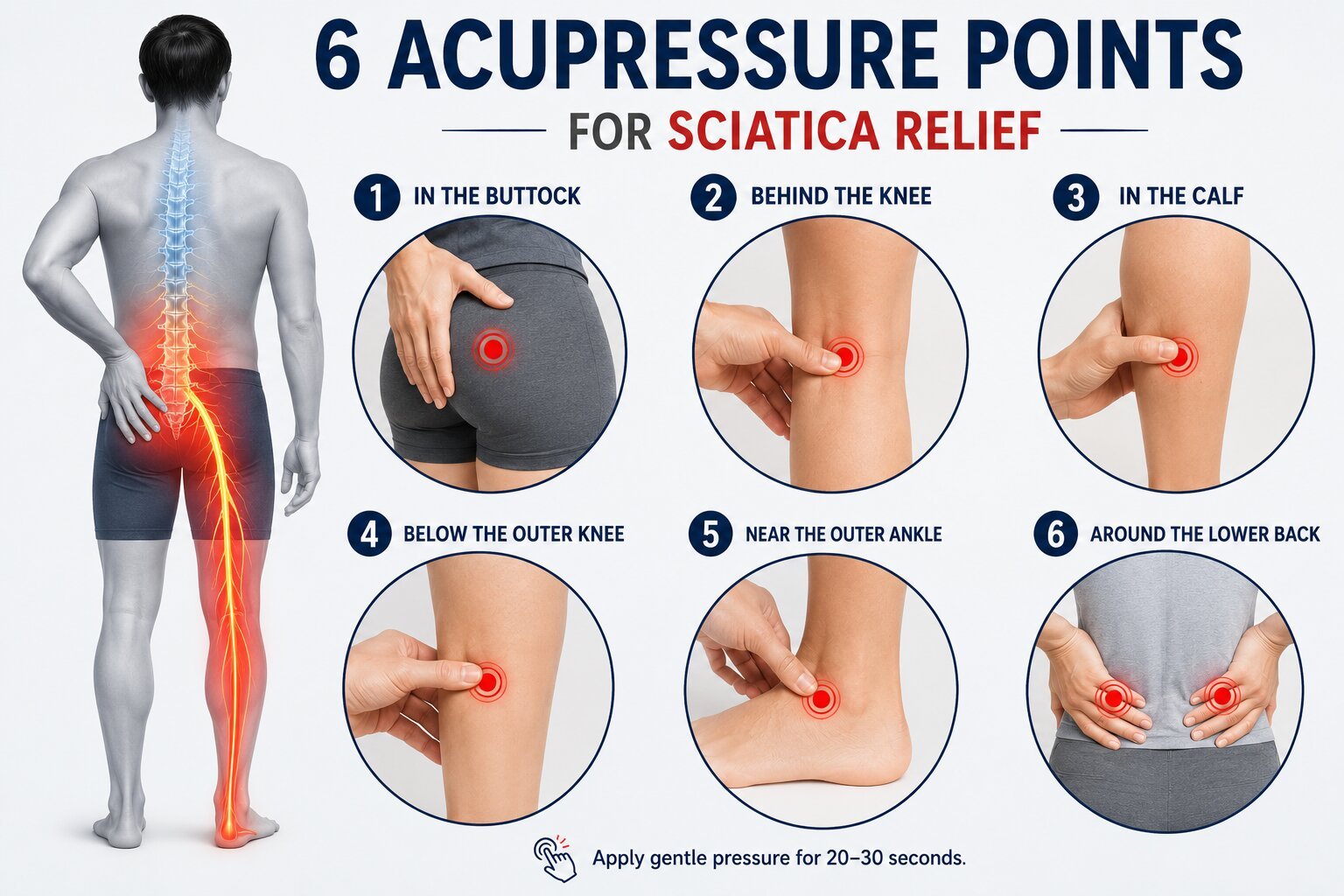
1. Pressure Point in the Buttock
One commonly used area is in the middle or outer part of the buttock, where many people with sciatica experience pain or tightness.
This area is close to the path of the sciatic nerve, so it may feel tender when the surrounding muscles are tight.
How to try it
- Sit or lie down comfortably.
- Relax the buttock muscles.
- Use your thumb or fingertips.
- Apply gentle pressure to a tender but comfortable area.
- Hold for around 20–30 seconds.
- Release slowly.
- Repeat 3–5 times if it feels comfortable.
You should feel pressure or mild tenderness.
Do not press hard enough to produce sharp, electric or shooting pain down the leg.
2. Pressure Point Behind the Knee
Another commonly used area is the soft part in the middle of the crease behind the knee.
Some traditional pain-relief techniques use this area for lower back and leg discomfort.
How to try it
Sit comfortably and keep the leg relaxed.
Use your thumb to apply gentle pressure to the soft area behind the knee.
Hold for approximately 20–30 seconds and then release.
You can repeat this a few times.
Be careful
Do not apply deep pressure if you have:
- Knee swelling
- A recent knee injury
- Significant tenderness
- Unexplained pain behind the knee
3. Pressure Point in the Calf
A commonly used pressure area is located in the upper-middle part of the calf, below the back of the knee.
People sometimes find this area tight or tender when they have pain travelling down the back of the leg.
How to try it
- Sit with your leg relaxed.
- Use your thumb to find a comfortable tender spot in the calf.
- Apply gentle pressure.
- Hold for 20–30 seconds.
- Release.
- Repeat a few times.
Do not massage the calf aggressively.
Important
If you have sudden calf swelling, redness, warmth or severe calf pain, do not assume it is sciatica and do not massage the area. Seek medical advice.
4. Pressure Point Below the Outer Knee
Another area commonly used for leg and lower-back discomfort is just below and slightly outside the knee.
You may find a slightly tender spot in the upper outer part of the lower leg.
How to try it
Use your thumb and apply comfortable pressure for around 20–30 seconds.
Release and repeat 3–5 times.
There is no need to press very hard.
If you develop numbness, tingling or shooting pain while pressing, stop.
5. Pressure Point Near the Outer Ankle
A commonly used area for lower-leg discomfort is located between the outer ankle bone and the Achilles tendon.
The area may feel slightly tender when pressure is applied.
How to try it
- Sit comfortably.
- Keep your ankle relaxed.
- Use your thumb.
- Apply gentle pressure to the soft area beside the Achilles tendon.
- Hold for around 20 seconds.
- Release slowly.
Avoid this area if you have a recent ankle injury, swelling or significant pain around the ankle.
6. Gentle Pressure Around the Lower Back
The lower back is another area where people often use gentle massage or pressure for pain relief.
However, do not press directly and forcefully on the spine.
Instead, use your fingertips or palm to gently massage the muscles on either side of the lower spine.
Try this for a few minutes
Use slow, gentle circular movements around the muscles of the lower back.
Stop if the pain increases or begins travelling further down the leg.
For people with severe back pain, recent trauma or significant osteoporosis, deep pressure over the lower back should be avoided unless advised by a healthcare professional.
How Long Should You Press an Acupressure Point?
There is no universally accepted home-treatment schedule specifically for sciatica.
If you want to try gentle acupressure, a simple approach is:
20–30 seconds of gentle pressure → release → relax → repeat a few times.
You do not need to use strong pressure.
In fact, more pressure does not necessarily mean more relief.
The aim is to make the area feel comfortable, not to cause pain.
Should Acupressure Hurt?
No.
You may feel mild pressure, tenderness or a dull aching sensation.
But you should stop if you experience:
- Sharp pain
- Electric-shock-like pain
- Increasing numbness
- New tingling
- Weakness
- Severe tenderness
- Increasing pain travelling down the leg
If a particular point repeatedly makes your symptoms worse, do not continue pressing it.
Can Acupressure Cure a Slipped Disc?
No.
This is one of the most important things to understand.
If your sciatica is caused by a slipped or herniated disc pressing on a spinal nerve, acupressure cannot physically remove the disc or correct the pressure on the nerve.
It may provide temporary comfort for some people, but it does not treat the structural cause.
The same applies to other causes of sciatica, such as narrowing around the spinal nerves.
This is why persistent sciatica should be properly assessed instead of being treated only with home remedies.
Acupressure vs Exercise for Sciatica
If you have sciatica, you may wonder whether you should use pressure points or exercises.
They are not really alternatives.
Acupressure may help some people feel more comfortable for a short period, while appropriate movement and exercise can form an important part of longer-term management.
Current clinical guidance encourages people with low-back pain and sciatica to remain active and consider exercise-based management rather than prolonged bed rest.
However, the right exercises depend on your symptoms.
An exercise that feels good for one person may make another person’s sciatica worse.
So avoid blindly following every “best exercise for sciatica” video you see online.
Other Ways to Get Sciatica Pain Relief at Home
Along with gentle movement, some people may find the following measures helpful:
Keep moving
Try not to stay in bed or sit in one position for long periods.
Short, comfortable walks may be better than complete rest.
Take regular breaks from sitting
If you have a desk job, get up regularly and move around.
Try a comfortable sleeping position
Find a position that reduces pressure and allows you to sleep comfortably.
Some people find side sleeping with a pillow between the knees more comfortable.
Use heat for comfort
A warm pack may help relax tight muscles and provide temporary comfort.
Avoid placing very hot objects directly on the skin.
Follow a suitable exercise programme
If sciatica continues, a physiotherapist or doctor can help you choose exercises based on the cause of your symptoms.
How Long Does Sciatica Usually Last?
The duration of sciatica varies from person to person.
Some people improve within a few weeks, while others can have symptoms for longer.
Recovery depends on factors such as:
- The cause of sciatica
- Severity of nerve irritation
- Duration of symptoms
- Presence of weakness or numbness
- Overall physical condition
- Response to treatment
Do not judge the seriousness of sciatica only by how much pain you have.
Numbness or weakness can be more important than pain intensity alone.
When Should You See a Doctor for Sciatica?
You should consider seeing a doctor or pain specialist if:
- Your pain is severe
- Pain is getting worse
- Symptoms continue for several weeks
- Pain is affecting sleep
- You are finding it difficult to walk or work
- You have persistent numbness or tingling
- You notice weakness in your leg or foot
- Sciatica keeps coming back
- Home treatment is not helping
A proper examination can help determine whether the pain is actually coming from the sciatic nerve and what may be causing it.
An MRI is not automatically required for every person with sciatica. NICE guidance recommends considering imaging in a specialist setting when the result is likely to change treatment decisions.
Sciatica Red Flags: When You Need Urgent Medical Attention
Some symptoms should not be treated at home with acupressure or massage.
Seek urgent medical attention if you develop:
- Severe or worsening weakness in the legs
- Numbness around the genital area
- Numbness around the anus
- Difficulty passing urine
- Loss of bladder control
- Loss of bowel control
- Severe symptoms affecting both legs
These symptoms can indicate serious nerve compression and require urgent medical assessment.
Can You Massage the Sciatic Nerve?
It is better not to aggressively massage the area where you feel sciatic nerve pain.
The sciatic nerve is sensitive when it is irritated.
Deep pressure that causes shooting or electric pain down the leg can make symptoms worse.
Gentle massage of the surrounding muscles may feel comfortable for some people, but it should not be used as a substitute for diagnosis and treatment when symptoms persist.
What If Acupressure Gives Temporary Relief?
Temporary relief is possible, but it does not necessarily mean the underlying problem has gone away.
For example, if your pain is caused by irritation of a spinal nerve, you may feel better after massage or pressure because the surrounding muscles become more relaxed.
But the underlying nerve irritation may still be present.
So if your pain repeatedly returns after temporary relief, it is worth getting the cause checked.
Is Acupressure Safe for Everyone?
Gentle acupressure is generally considered a low-risk complementary approach, and studies of acupressure for low-back pain have reported relatively few serious adverse events. However, the evidence base has limitations and this does not mean it is suitable for every person or every type of pain.
Avoid forceful pressure over:
- Injured areas
- Swollen areas
- Infected skin
- Open wounds
- Areas with unexplained severe pain
Also avoid self-treatment as your only approach if you have significant numbness, weakness or other neurological symptoms.
Frequently Asked Questions
What are the best acupressure points for sciatica?
There is no scientifically proven single “best” acupressure point for sciatica.
Commonly used areas include the buttock, behind the knee, calf, outer lower leg, outer ankle and muscles around the lower back.
Acupressure may provide temporary comfort for some people, but it should not be considered a cure for the underlying cause of sciatica.
Where should I press for sciatic nerve pain?
You can try gentle pressure around the buttock, calf, area behind the knee or other commonly used pressure areas described above.
Do not press directly on the spine or aggressively press a painful nerve.
If pressure produces shooting pain, numbness or tingling, stop.
Can I use acupressure for sciatica every day?
There is no well-established evidence-based schedule for self-applied acupressure specifically for sciatica.
If you choose to try it, keep the pressure gentle and stop if symptoms worsen.
If you need to keep using acupressure every day just to control your pain, it is better to find out why the pain is continuing.
Can acupressure give immediate relief from sciatica?
Some people may feel temporary relief after pressure or massage, but there is no guarantee of immediate relief.
Acupressure should not be expected to remove the cause of nerve compression.
Can acupressure fix a slipped disc?
No.
Acupressure cannot physically move a slipped disc back into place or remove pressure from a compressed nerve.
If a slipped disc is causing persistent sciatica, the appropriate treatment depends on the severity of symptoms and neurological findings.
Is walking good for sciatica?
For many people with uncomplicated sciatica, gentle movement and staying reasonably active are preferable to prolonged bed rest.
However, if walking significantly increases your pain, causes weakness or produces other concerning symptoms, you should get medical advice.
Is heat good for sciatic pain?
Heat may provide temporary comfort, particularly if there is associated muscle tightness.
Use a comfortably warm pack rather than very high heat, and protect your skin.
Which is better for sciatica: massage or acupressure?
Both are complementary approaches and neither should be considered a universal treatment for sciatica.
The most appropriate treatment depends on the underlying cause of the nerve pain.
When should I stop home treatment for sciatica?
If your symptoms are getting worse, continuing for several weeks, affecting your daily activities, or associated with numbness or weakness, it is time to get your symptoms evaluated.
Do not continue home treatment if you develop bladder or bowel problems or numbness around the genital or anal area.
Final Takeaway
Acupressure can be an option for people who are looking for a simple, non-invasive way to manage discomfort at home. Research suggests that acupressure may help with some types of low-back pain, although the quality of evidence is variable.
For sciatica specifically, research on acupuncture is more extensive and suggests potential benefits for pain relief, but current evidence still has limitations.
The most important thing to remember is:
Acupressure may help you feel better, but it does not necessarily treat the reason why you have sciatica.
If your pain is persistent, severe or associated with numbness or weakness, don’t keep trying different pressure points at home. Get the cause of your pain properly assessed.
At Dr. Ekta Gupta’s pain clinic, the focus is on identifying the source of pain and selecting treatment according to the individual patient’s symptoms and condition.
If your sciatica is affecting your sleep, work, walking or daily life, a proper evaluation can help you understand what is causing the pain and what treatment options may be suitable for you.
Medical References
- Li T, Li X, Huang F, et al. Clinical Efficacy and Safety of Acupressure on Low Back Pain: A Systematic Review and Meta-Analysis. Evidence-Based Complementary and Alternative Medicine. 2021.
- Godley E, Smith MA. Efficacy of acupressure for chronic low back pain: A systematic review. Complementary Therapies in Clinical Practice. 2020.
- Han KH, Cho KH, Han C, et al. The effectiveness and safety of acupuncture treatment on sciatica: A systematic review and meta-analysis. Complementary Therapies in Medicine. 2022.
- Zhang Z, Hu H, Huang F, et al. The efficacy and safety of acupuncture therapy for sciatica: A systematic review and meta-analysis of randomized controlled trials. Frontiers in Neuroscience. 2023.
- Zhang J, et al. Acupuncture Therapy for Sciatica: An Overview of Systematic Reviews and Meta-Analysis. Journal of Pain Research. 2025.
- Qin Z, Liu X, Wu J, et al. Effectiveness of Acupuncture for Treating Sciatica: A Systematic Review and Meta-Analysis. Evidence-Based Complementary and Alternative Medicine. 2015.